
How to Sell Claude Skills: Turn Your Expertise Into a Product
A marketing consultant made $3,000 selling Claude skills he already used. Here's how to find your sellable expertise and package it into a skill tonight.

A couple of days ago I listened to an episode of Chris Koerner’s podcast where he interviewed Ryan Dozer, a marketing consultant who runs his agency by himself. Non-technical.
About 45 days before the interview, Ryan took 25 Claude skills he’d built for his own client work and listed them on his website for $99. No ads, no launch. Just a popup and a few links in his emails. In 45 days it made $3,000, almost all profit.
He built nothing new for it. The skills already existed, he used them every day, he just packaged what he was already doing.
If you’ve been reading me for a while, you know how I feel about Claude skills. They’re the smallest, simplest form of automation you can build, and they make your work both better and faster.
I’ve shared a lot of my best ones with you already, mostly inside the premium subscription. So Ryan’s story felt familiar. He sells files, I bundle mine into this newsletter. Same move, different packaging.
After the episode I did the math. The 9 articles where I shared skills have converted around 300 readers from free to paid. They’re among my best-converting posts.
Still, I don’t share most of what I build. I’m close to 80 skills now, but only the best ones go out. That filter is why they convert. The best ones came from solving my own problem, the kind you can’t fake and can’t search for. Real value from real experience, in front of the right audience.
And with Claude, the writing part of a skill is easy. It formats it in minutes. The hard part is everything before that.
Knowing your own process is worth packaging, figuring out which part, whether there’s real demand for it, and pulling it out of your head in enough detail to actually work. But almost nobody with that expertise is selling them yet.
The people doing it are AI people like me, building skills for writing, marketing, automation, the things we do all day. The domain experts, the tax accountants, the lawyers, the product managers, the people with twenty years in a niche field, are barely there.
Which means the field is wide open for them. For you, maybe.
And of all the things you could sell, a skill is the simplest. You could build an app with Claude Code or put together a course or an ebook, and those are great too.
But whoever buys a skill can use it right away and their output gets better on the spot. That’s why skills work so well, and why they’re one of the easiest ways to start a side hustle with AI.
So I created two prompts. One maps what you know and checks it against real demand, so you see what’s sellable. The other pulls one area out of your head and packages it as a skill. I'm sharing both today, so you can start tonight.
Here’s what we’ll cover:
What a Claude skill is, and why your experience is the part that sells
The expertise you can’t see in yourself: a real example
Who can make money selling Claude skills
Two workflows to find and build a sellable skill
Workflow 1: map what you know and check real demand
Workflow 2: turn one idea into a finished Claude skill
How to test your skill, and three ways to sell it
What a Claude skill is (and why your experience is the part that sells)
If you're new, here's the whole thing in one line: a Claude skill is a recipe. A text file that teaches Claude to do one task your way, every time, without you re-explaining yourself in every chat.
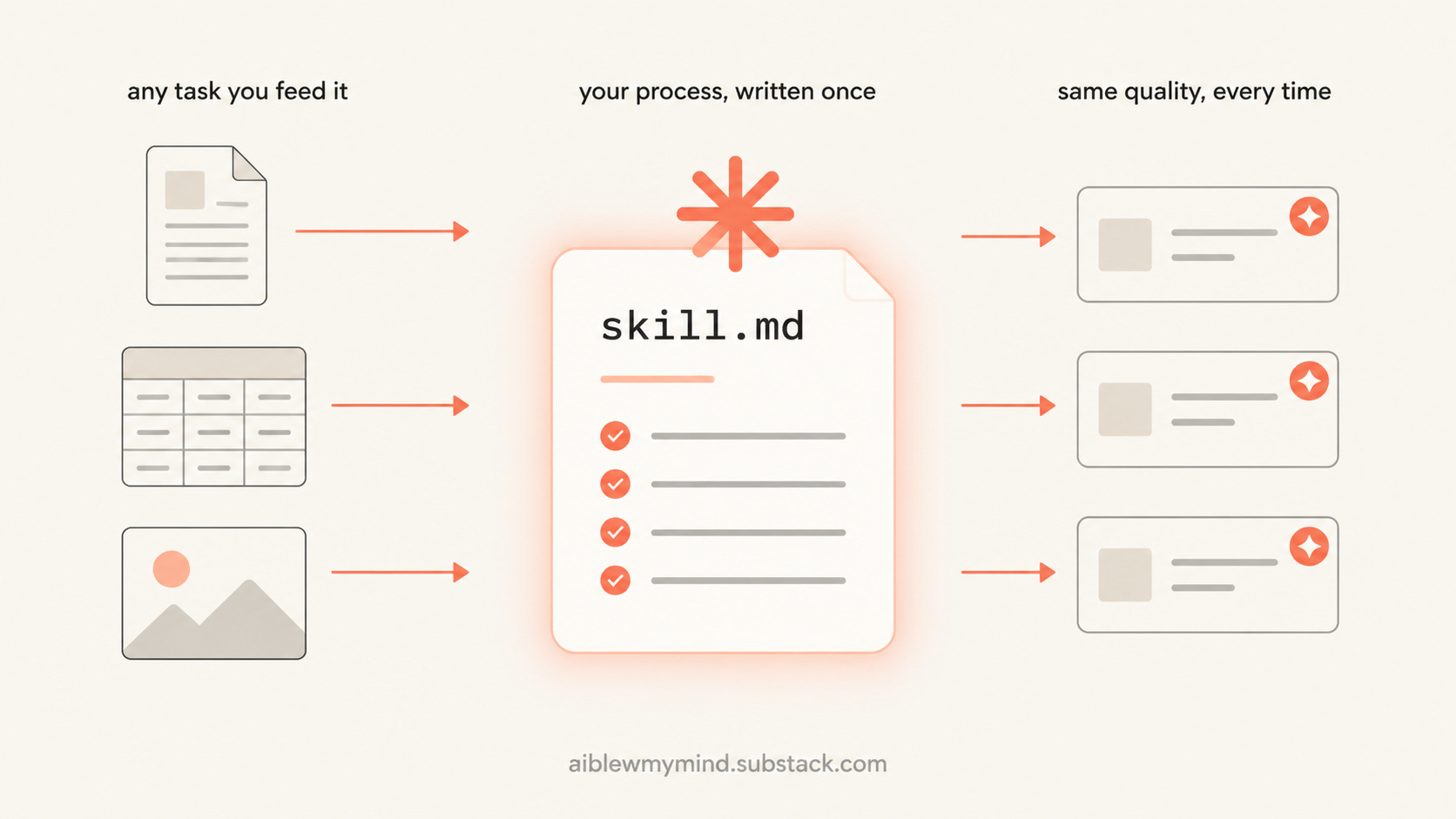
I have skills that write in my voice, build branded documents, structure my articles, make carousels and lead magnets, generate thumbnails, and turn my chats into repeatable workflows. And that’s a fraction of them.
The part that makes a skill worth money is the judgment inside it. What people pay for is the battle-tested way of doing things that’s proven to work.
And the best proof I have isn’t me. It’s my mom.
A real example: how my non-technical mom automated part of her work with Claude skills
Here’s what that looks like with someone who’d never call herself technical.
My mom works in finance. Part of her job is uploading invoices and customer data into an old Romanian accounting program, the kind with no API. So she did it the only way the software allowed, one entry at a time. Upload a customer. Upload an invoice. Upload the next one. For hours.
We sat down together. First we pulled out her expertise. Which tax rules apply to which invoice, the law behind each one, what has to travel with every entry to stay compliant, which account it belongs to. Lots of small rules that only someone who does this would know. That part only she knew.
Then I brought my side: a way to get all of it into the software. We built a set of skills and commands that take her raw data, apply her logic, and turn it into an XML file the program accepts.
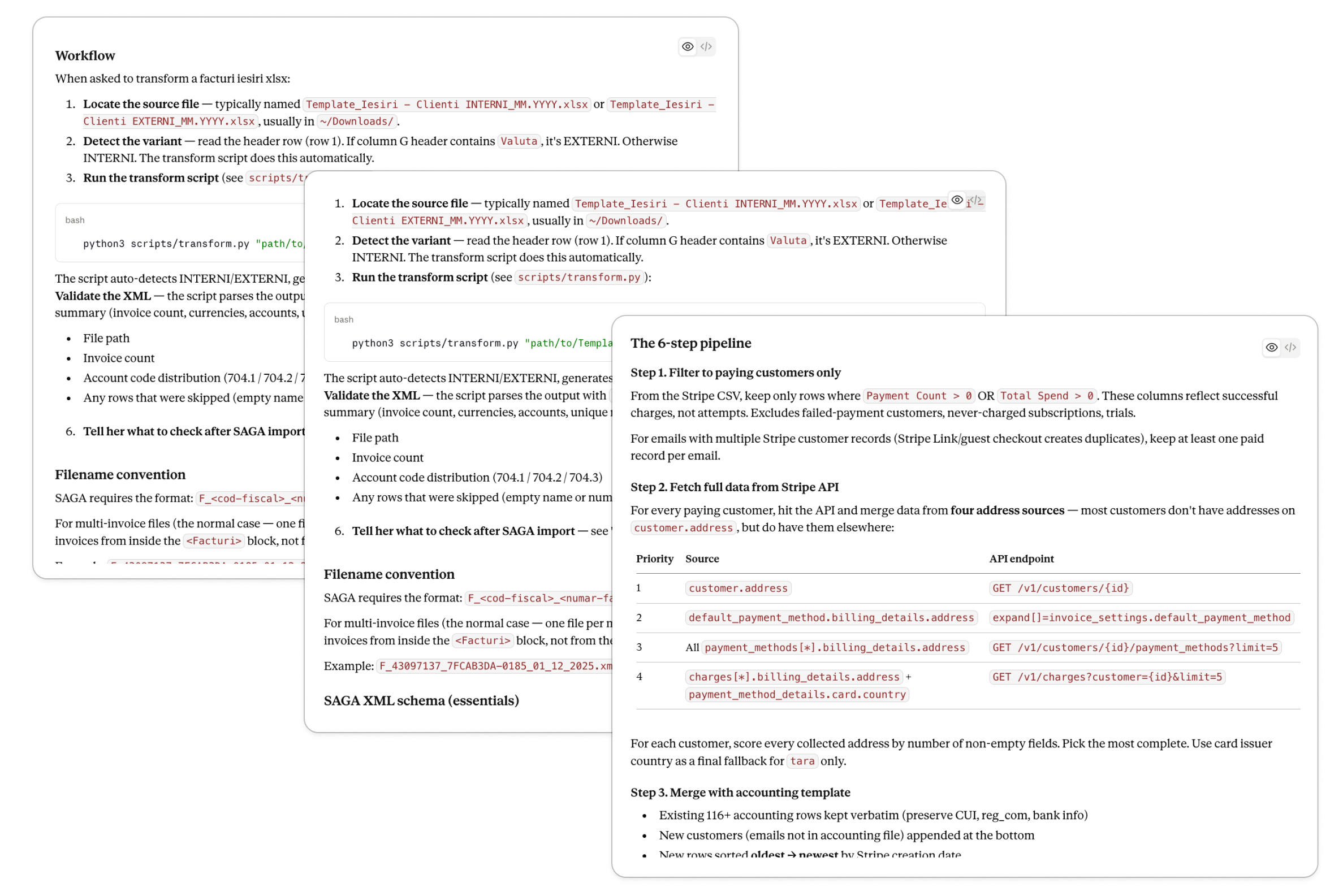
Now she imports everything in one go instead of line by line. And after we tested it and it worked, this was her reaction:
This one leaned more technical than most, the transform needed my side as much as hers. But that’s the point. Her expertise was the part you can’t Google. The technical glue was the easy half, exactly the kind of thing a skill handles for you.
A skill like this could sell to every other person in her role, on the same software, stuck doing the same thing by hand.
And it’s not just her. Most people have a version of this in them, they just don’t see it sometimes.
So who can make money selling Claude skills?
It shows up in all kinds of places, and one of these is probably you:
You have real experience in your role. Years of processes, checklists, and judgment calls that feel routine to you and would save someone else months.
You run a business or consult. Your methodology is already a product. It’s just not packaged yet.
You have a hobby you’ve gone deep on. Gardening, cooking, collecting, coaching. Depth is depth.
You want a side hustle. This is the lowest-barrier digital product I’ve seen. No app to build, no course to record.
And one more thing: you don’t need a stack of existing skills to start, the way Ryan did. You can build them now. Most of mine took a lot of iteration before they were good enough to share, and the first place they paid off was my own work. Same for you. A skill that runs one of your weekly tasks your way is useful to you and your team from day one. Selling it later is the bonus.
Two workflows to find and build a sellable Claude skill
So the real question isn’t whether you have something worth packaging. You do. It’s which piece, whether anyone wants it, and whether it’s worth your evening before you spend it. These two workflows answer all three.
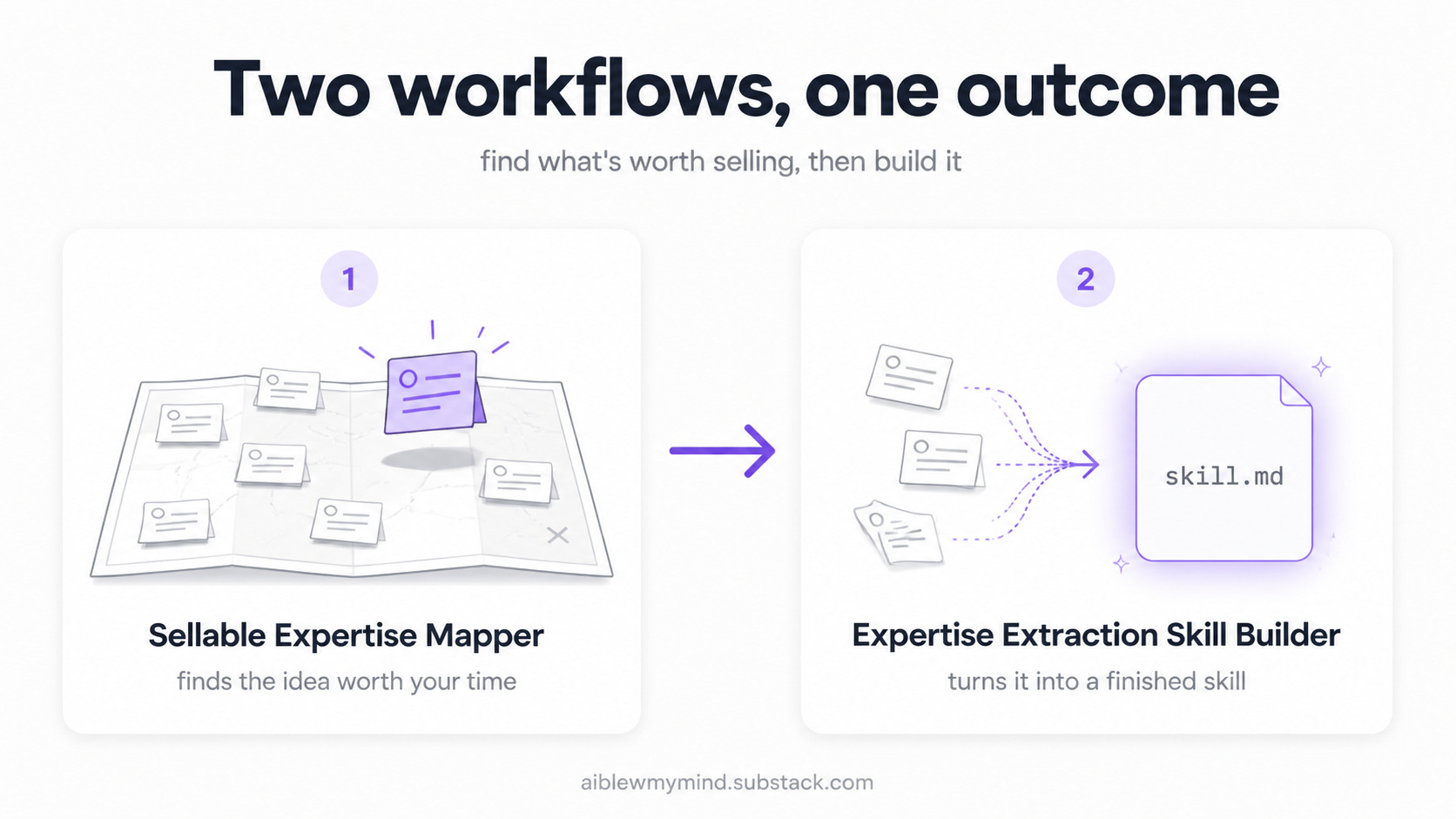
The first finds your idea. It surfaces the expertise you’ve stopped noticing, weighs each piece against what people actually search for and buy, and tells you which one is worth your time.
The second builds it. You point it at the idea you picked, and it helps you turn what’s in your head into a finished, sellable skill. The kind of thing you could use Monday morning or put a price on the same day.
By the end you’ll have a map of everything you could sell, the single best idea to start with, and a finished skill in your hands. Upgrade to access the two workflows.