

One of my paid subscribers, Steve, wrote to me recently. Here’s what he said:
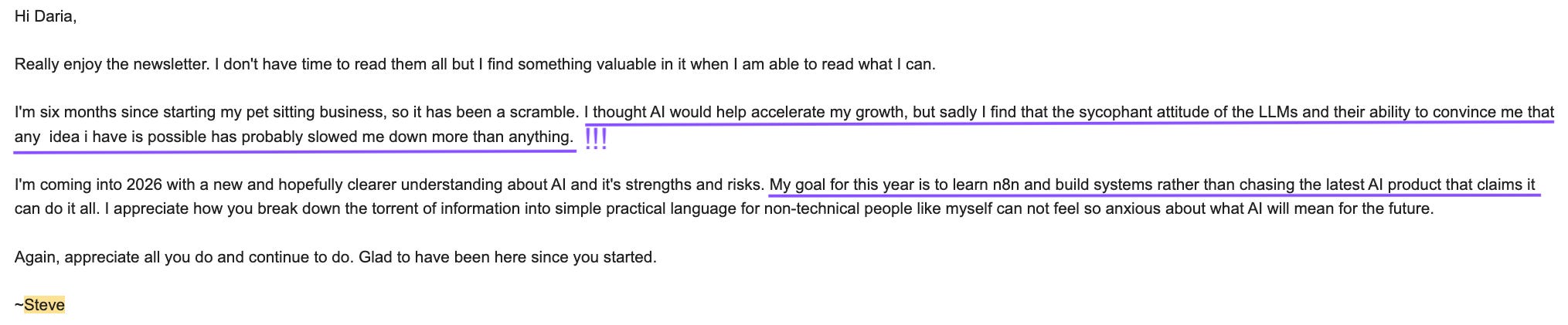
“I find that the sycophant attitude of the LLMs and their ability to convince me that any idea I have is possible has probably slowed me down more than anything.”
I feel this pull constantly too.
Every week there’s a new tool. A new capability. A new thing I “should” be testing, exploring, writing about for you, or working on to improve my own systems.
Every tool promises something. Every new capability opens a door. And AI is right there, ready to help us do all of them.
But when everything becomes possible, choosing becomes the hardest part. And it only gets harder when the options are endless and shiny object syndrome has a hold on us all.
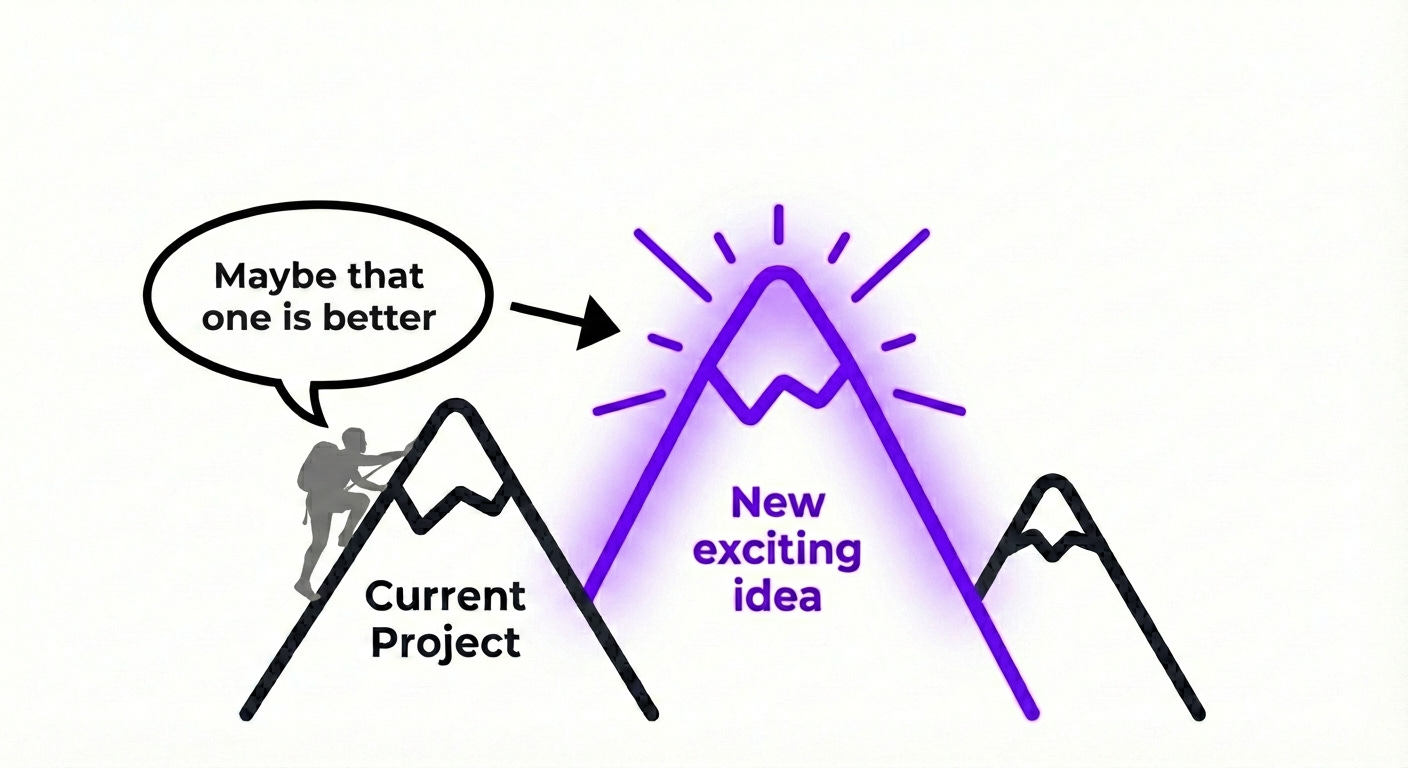
That feeling of not doing enough, not keeping up, not using AI to its full potential, isn’t a personal failure.
It’s a symptom of having tools without a way to think about them.
And that’s what we’re going to talk about today.
What we’ll cover:
Why you’re not seeing results despite all the tools you’ve tried
A framework for deciding what’s worth your time
Five principles to build systems that compound
Case study: my actual system for writing (and how it evolved)
Why you’re not seeing results
AI is evolving faster than anyone can keep up with. So you try things. You experiment. You feel that spark of possibility. And that's good. Trying new tools is how you learn what works for you.
The problem is when nothing sticks. When every experiment stays an experiment. When you keep starting but never building.
A hammer is useless without knowing what you’re building. Most of us have been handed increasingly sophisticated hammers while standing in an empty lot, wondering why the house isn’t appearing.
The tools aren’t the problem. What’s missing is knowing what moves the needle for you. Not in general. For your specific goals, your specific bottlenecks, your specific situation.
And that requires a different way of thinking.
The missing piece
So how do you stop spinning and start building? How do you know what to connect and what to ignore? What’s worth your patience and what’s just another distraction?
There’s a way of thinking that helps. It’s been around for decades in fields like engineering and organizational design, but we don’t talk about it enough.
It’s called systems thinking.
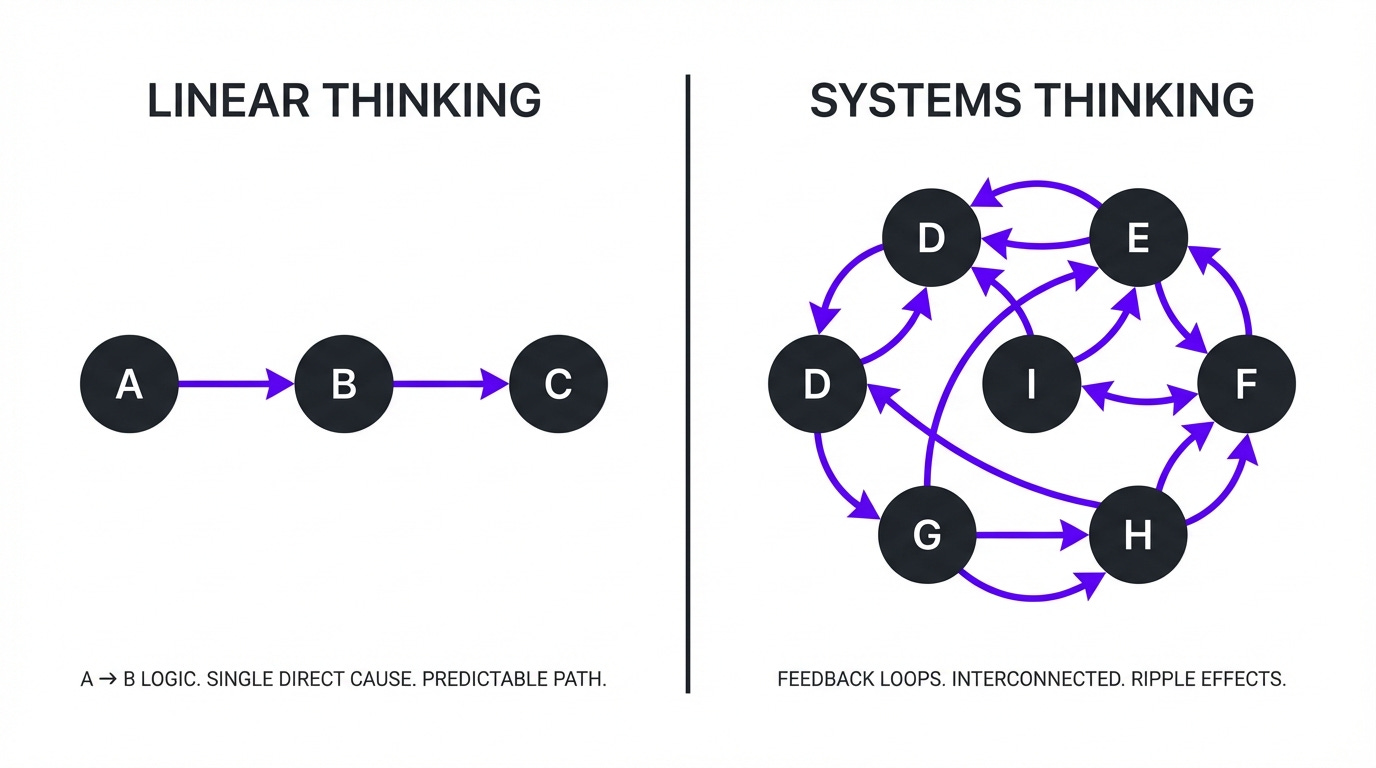
Linear thinking asks: What do I want to do? → How do I do it?
Systems thinking asks: What am I actually trying to achieve? → What’s connected to what? → Where’s the real constraint? → What happens if I intervene here?
Linear thinking treats problems as isolated. Fix this thing, get that result.
Systems thinking recognizes that everything is connected. Actions have ripple effects. Problems persist because something is maintaining them. Solutions in one area create problems in another.
See if you recognize yourself in any of these:
Notice the pattern?
The linear approach adds more. More AI output. More volume. It tends to treat symptoms rather than root causes. And in doing so, it creates new problems to deal with.
The systems approach asks: what's actually causing this problem? Am I even looking at the right thing? And where should I intervene to fix it for good?
When something isn’t working, our instinct is to throw more at it. More tools. More prompts. More effort. But if you’re fixing the wrong problem, more won’t help. And if the real issue is structural and you’re addressing symptoms, you’ll just end up busy, not productive.
Before the prompts, before the automations, before the tools, this is the thinking that determines whether any of it helps.
It's what gives you the clarity to know where to focus your energy instead of spreading it across everything that seems promising.
The new direction: how to think in systems
Now let's make it practical. Here are the principles that can help you start designing systems, stop spreading yourself thin, and know where to invest your effort to get results.
Principle 1. Start with the outcome, not the activity
Linear thinking says: “I need to post more on LinkedIn.”
Systems thinking says: “What am I actually trying to build by posting on LinkedIn?”
Posting is an activity. But what’s the goal behind it? Building a brand? Generating inbound leads? Finding a job? Each one requires a different approach.
The systemic fix: Before you build anything, name the outcome. Then ask: does this activity actually connect to that outcome? If you can't draw a clear line between what you're doing and what you're trying to achieve, pause.
Ask yourself: What am I actually trying to accumulate?
Principle 2. Find the real constraint
Linear thinking says: “I’m not growing, so I need to do more of everything. More tools! More AI!”
Systems thinking says: “There is one specific thing holding back the whole system. Find it.”
If you have 47 tabs open because you can’t decide what to write about today, adding an AI tool that generates 1,000 headlines won’t help. The constraint isn’t content generation. It’s decision making.
The systemic fix: Instead of adding a new task, you need a rule. Something like: “I only write about things I’ve personally tested or experienced this week.”
Ask yourself: What’s the real bottleneck? Not the annoying thing. The limiting thing.
Principle 3. Structure determines behavior
Linear thinking says: “I need more discipline. I need to try harder.”
Systems thinking says: “If I keep getting the same result, the structure is creating it.”
If you keep forgetting to follow up with leads, using an AI tool to do more outreach and close more deals won’t solve it. You’ll just have more leads to forget about. The real problem is that follow-up isn’t built into your workflow. There’s no trigger, no reminder, no place where “follow up” naturally happens.
The systemic fix: Change the structure. Build something simpler. Attach it to an existing habit. Make the default path the one you want.
Ask yourself: What structure is causing this pattern?
Principle 4. Build feedback loops
Linear thinking says: “I’ll set this up and it’ll run forever.”
Systems thinking says: "How will I know if this is actually working? And how will it get better over time?"
Systems aren’t “set and forget”. They have to grow with you. If you have a Gem for generating on-brand visuals and it keeps using the wrong style, go back to the instructions and update them. That’s how you close the feedback loop and keep the system relevant.
The systemic fix: When something breaks twice, don’t just fix it. Update the system so it doesn’t break again.
Ask yourself: When something fails, does that information go back into the system? Or does it disappear?
Principle 5. Resist the urge to add
Linear thinking says: “This isn’t working, so I need something new.”
Systems thinking says: “What if I removed something instead?”
Remember the Gem that kept missing your brand style? If you never go back to fix the instructions, you’ll eventually abandon it and try a new tool. Then another. When you don’t invest in making what you have work, you’ll always be tempted by the next shiny thing.
The systemic fix: Before adding something new, ask: have I really made my current tools work for me? What could I stop doing instead?
Ask yourself: Do I need something new, or do I need to fix what I already have?
What a simple system looks like
Let’s make this concrete. Take writing, since that’s something most of us do in some form.
Using AI as a tool
You open ChatGPT, type “write me a LinkedIn post about productivity”, and get something generic. It doesn’t sound like you.
You add “make it conversational”. Still not right.
You try a different prompt you found online. Still generic.
You add more context: your audience, your style, an example of how you write. Finally, something usable. But it took six attempts to get there.
And next week, when you need another post, you start from scratch. All that context you added? Gone.
You’re back to square one, re-explaining who you are and how you write. Hunting for an even better prompt, hoping the right combination of words will unlock the magic output.
When that doesn’t work, you start wondering if ChatGPT is even the right tool for this. So you try a tool built specifically for LinkedIn writing. Then another one. Each promising to finally solve it.
This is tool thinking. Every session is isolated. Nothing compounds. And every “solution” adds more to your plate instead of getting you closer to where you want to be.
Using AI within a system
This looks a lot like my current system for writing. Let me show you how a system like this can evolve.
Phase 1: You start by documenting how you write, for whom, and why:
Your goals and context: Who you are, what your business does, what you’re trying to achieve with your content, what action you want readers to take, how this piece fits into the bigger picture.
Your audience: Who they are, what they’re struggling with, what language they use to describe their problems, what they’ve already tried, what they’re skeptical of.
Your voice DNA: You build this by feeding AI ten examples of your best writing and asking it to extract the patterns: the words you naturally use, the words you avoid, your sentence rhythms, how long your paragraphs tend to be, whether you use questions or statements, how you open and close pieces.
Phase 2: Then you embed all of this into a system.
You can start with a CustomGPT or a Gem, a Project, using any of the AI models you prefer. I personally now use Claude Skills for this (some new articles on this topic will follow!).
Phase 3: You keep investing in the system and the system starts growing with you.
Here’s an example of how it can evolve from here:
Iteration 1: You use the system for the first time. The output is decent, but the hooks are weak. So you add to your documentation: examples of hooks that work for you, what makes an opening grab attention, what to avoid. The system now has that knowledge to reference.
Iteration 2: You use it a few more times. You notice it keeps adding em dashes everywhere. The whole internet has turned against em dashes since AI came out, and you want to sound like yourself, not like a chatbot. So you go back to your voice DNA and add: “Never use em dashes. Use commas or periods instead.” Fixed.
Iteration 3: You realize you always create images to go with your posts. So you extend the system: every time it writes a post, it also generates three image concept prompts. You take those to your image generation tool, which has its own instructions about your brand colors, visual style, the aesthetic you’re going for.
Iteration 4: You want to stop doing this manually. So you connect it all in an n8n workflow. Now you have an end-to-end system.
I could keep going. But you get the point.
This is how systems grow. You build something, you use it, you learn what’s missing. Each friction teaches you something. Each iteration makes the output closer to what you need. The system evolves with you, as long as you have the patience to stick with it instead of chasing the next shiny thing.
That’s the difference. Tools reset. Systems compound.
Two ways I can help you build your systems
If you’ve read this far and you’re thinking “I get it, but where do I even start?”, I can help with that.
There are two paths, depending on how you like to work:
Path 1: The Blueprint (Premium Membership - $8/month or $70/year)
You want to build on your own terms, at your own pace. You just need the proven playbooks to know you’re not wasting time on things that don’t work.
With Premium, you get access to all paid issues of this newsletter and all premium content inside AI blew my mind LAB. The exact systems, automations, and workflows I build, with step-by-step guidance for you to replicate.
Path 2: The Shortcut (Founding Partner - $500/year)
You don't want to figure it out alone. You want me to look at your specific business, identify where AI makes sense, and help you build the systems that will move the needle.
As a Founding Partner, you hire me for 3 sessions of 1:1 consulting where we audit your workflows, build a tailored roadmap, and design the systems you need. You skip the months of trial and error.
Both paths lead to the same place: systems that actually work for you. The only question is whether you want to build it yourself or want a partner to guide you there.
Read the full details on both paths here and decide which one fits you.
Permission to do less
You cannot do everything. You will never use every tool. You will never build every automation. You will never keep up with every development.
That’s not failure. That’s reality.
For me, part of running this newsletter and doing consulting is staying on top of all these tools and updates. I try and test them so I can share what’s worth your attention. You get to choose what fits your situation.
But for my own systems? Not everything makes the cut. I keep investing in the systems I already have so they keep working harder for me. And every time I use them, I find another opportunity to improve them. With each iteration, they become more useful and more integrated into my work.
And that’s the point. Systems thinking gives you something valuable: a principled reason to say no.
When you understand what you’re building, your business, your life, your goals, you can evaluate everything against it. Does this fit my system? Does it address a real constraint? Or is it just another shiny thing?
I promise you, AI will blow your mind far more when the systems you build actually work for you than any shiny new tool ever could.
From the archive
A few recent pieces you might have missed:


Brilliant breakdown, Daria. Your point about 'Linear thinking' creating more volume while 'Systems thinking' identifies root constraints is essential.
In my research and in my fictional series The Digital Prophets, I see the 'tool-chasing' you describe as a symptom of the Infrastructure Gap—where users are handed increasingly complex 'AI Proxies' without the systemic understanding to govern them. Reclaiming the Ritual of Noticing within these systems is the only way to avoid becoming a 'Kusik' (a mere validator for the machine).
Looking forward to seeing how these compounding systems evolve! 🕯️🧭
Amazing article, Daria, and I cannot expect any less than that from you! 😅 Love how you integrated systems thinking into using AI and how staying put at what you are building, feeling it and improving it is more important than chasing new, shiny projects!