
The Rules of Ecommerce Just Changed: A Guide to the Universal Commerce Protocol
AI agents are now completing purchases without visiting your website. The businesses that optimize for them now will win the sales competitors miss.

Picture this: Someone tells their phone, “Find me wireless noise-canceling earbuds for running, sweat-resistant, under $150, and order them.”
Fifteen seconds later, a checkout sheet pops up right in the chat. They tap ‘Confirm’ and the purchase is done. No website. No product page. No comparing tabs.
This is agentic commerce, and it’s the biggest shift in ecommerce since mobile shopping.
We knew it will come since OpenAI announced their Agentic Commerce Protocol last September.
And four days ago, Google made it official with the “Universal Commerce Protocol”, built with Shopify and other major retailers like Target, Walmart, Wayfair, and Etsy.
It was inevitable, wasn’t it? People already use AI for everything and they want it for shopping too. (76% say they want AI-powered shopping assistants, while AI-driven traffic to U.S. retail websites jumped 4,700% from 2024 to 2025.)
What does this mean? Shortly put, AI is becoming the layer between people and what they buy online. So if you’re an online seller, you’re not just convincing customers anymore, you also have to ‘convince’ AI.
If your product data isn’t optimized for agents to parse, they won’t recommend your products and you become invisible to a growing slice of buyers.
I know a bunch of you reading run an ecommerce business, so let’s get into what’s happening and what you can do about it.
Here’s what we’ll cover:
What the Universal Commerce Protocol (UCP) is and why agentic commerce matters for ecommerce businesses in 2026
How to make your products discoverable by AI shopping agents
Two paths to get started (Shopify vs. custom integration)
6 rules for getting your products recommended by AI (+ action checklist for each)
New ecommerce metrics to track for agentic commerce
Step-by-step guide to plan your UCP implementation with AI
So… what is this and what changes?

The Universal Commerce Protocol (UCP) is a new open standard that allows AI assistants like Google Gemini or Google AI Mode to complete purchases directly inside a conversation, without the customer ever visiting your website.
Think of it like this: HTTP is the language that lets any web browser talk to any website. UCP is the language that lets any AI shopping agent buy from any online store.
Before this, AI could research products but then had to hand you off: “here are some options, go to their websites”. Now it closes the sale.
Here’s what that changes:
So if you sell online, you can no longer optimize just for human decision-making.
You also need to optimize for this massive new sales channel opening up, powered by AI agents: consistent data, complete specs, accurate inventory, reliable fulfillment.
How a purchase happens now
When someone asks an AI for “running earbuds under $150”, the agent finds products, compares them, and completes the purchase - all without leaving the chat.
Here’s what that looks like step by step:
Shortly put, the AI is doing the work your website used to do. Product discovery, comparison, checkout, order tracking.
And that’s a great opportunity for you to get this right early, so you’re showing up in this new search engine before everyone else (aka your competitors) know it exists.
The two paths to get started
There are two ways to make your products available for AI shopping.
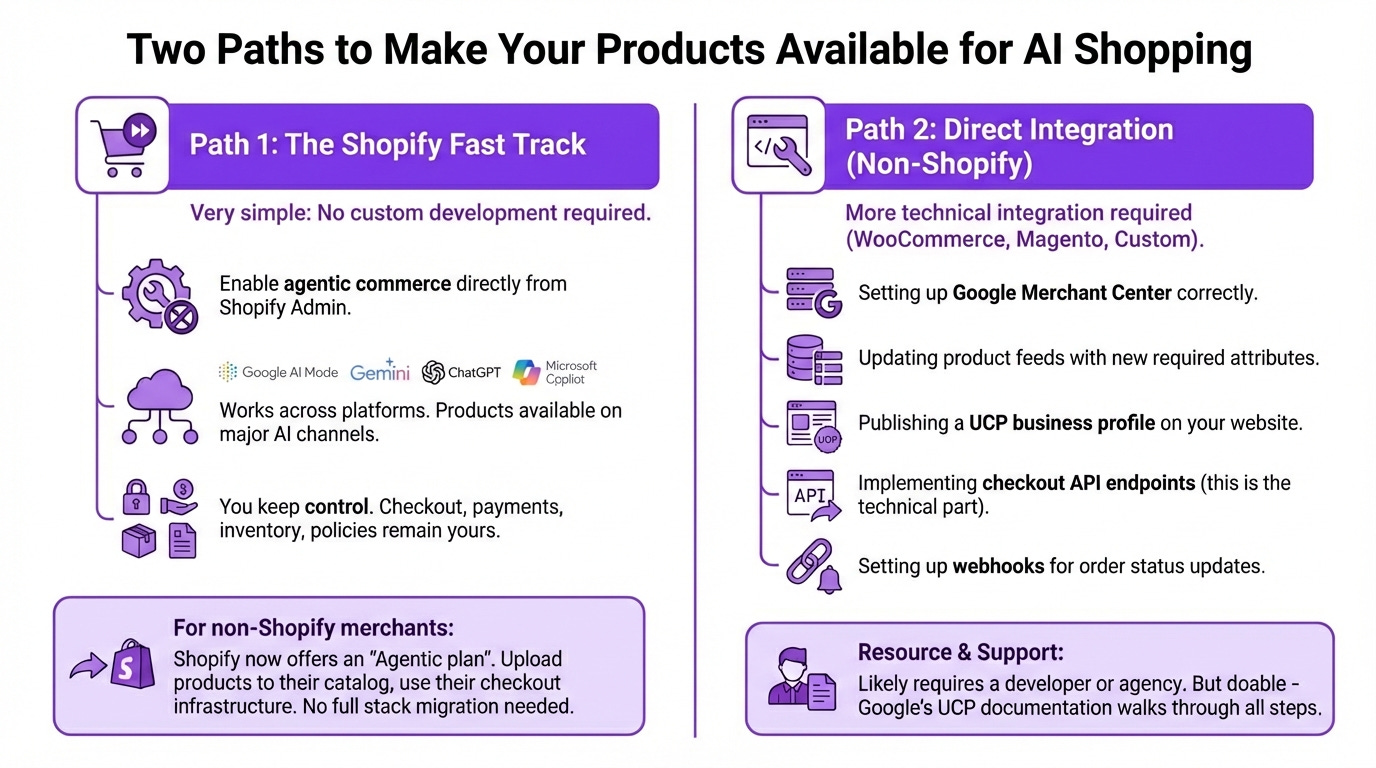
Path 1: The Shopify fast track
This is very simple:
No custom development required. You enable agentic commerce from your Shopify Admin.
Works across platforms. Your products become available on Google AI Mode, Gemini, ChatGPT, and Microsoft Copilot.
You keep control. Checkout, payments, inventory, business policies: all still yours.
If you’re not on Shopify but want this fast track, Shopify now offers an “Agentic plan” specifically for this. You upload your products to their catalog and use their checkout infrastructure to sell through AI channels. You don’t need to migrate your entire ecommerce stack.
Path 2: Direct integration (for non-Shopify merchants)
If you’re on WooCommerce, Magento, or something custom-built, you’ll need a more technical integration:
Setting up Google Merchant Center correctly
Updating your product feeds with new required attributes
Publishing a UCP business profile on your website
Implementing checkout API endpoints (this is the technical part)
Setting up webhooks for order status updates
This path likely requires a developer or agency. But it’s doable - Google’s UCP documentation walks through all the steps.
If this helped you understand something new, share it with another business owner who sells online. This shift affects everyone, and the more people who understand it early, the better prepared we’ll all be.
The full rundown: what you need and how to do it for your store
Technical integration is one thing. Actually getting chosen by AI agents is another.
Here’s what I’ve gathered about what makes products more likely to be recommended, with a checklist for each.
At the end of this section, I’ll also share:
The ecommerce metrics you need to track for agentic commerce
An interactive NotebookLM project that will help you set up UCP for your own business
A step-by-step guide on how to use it