

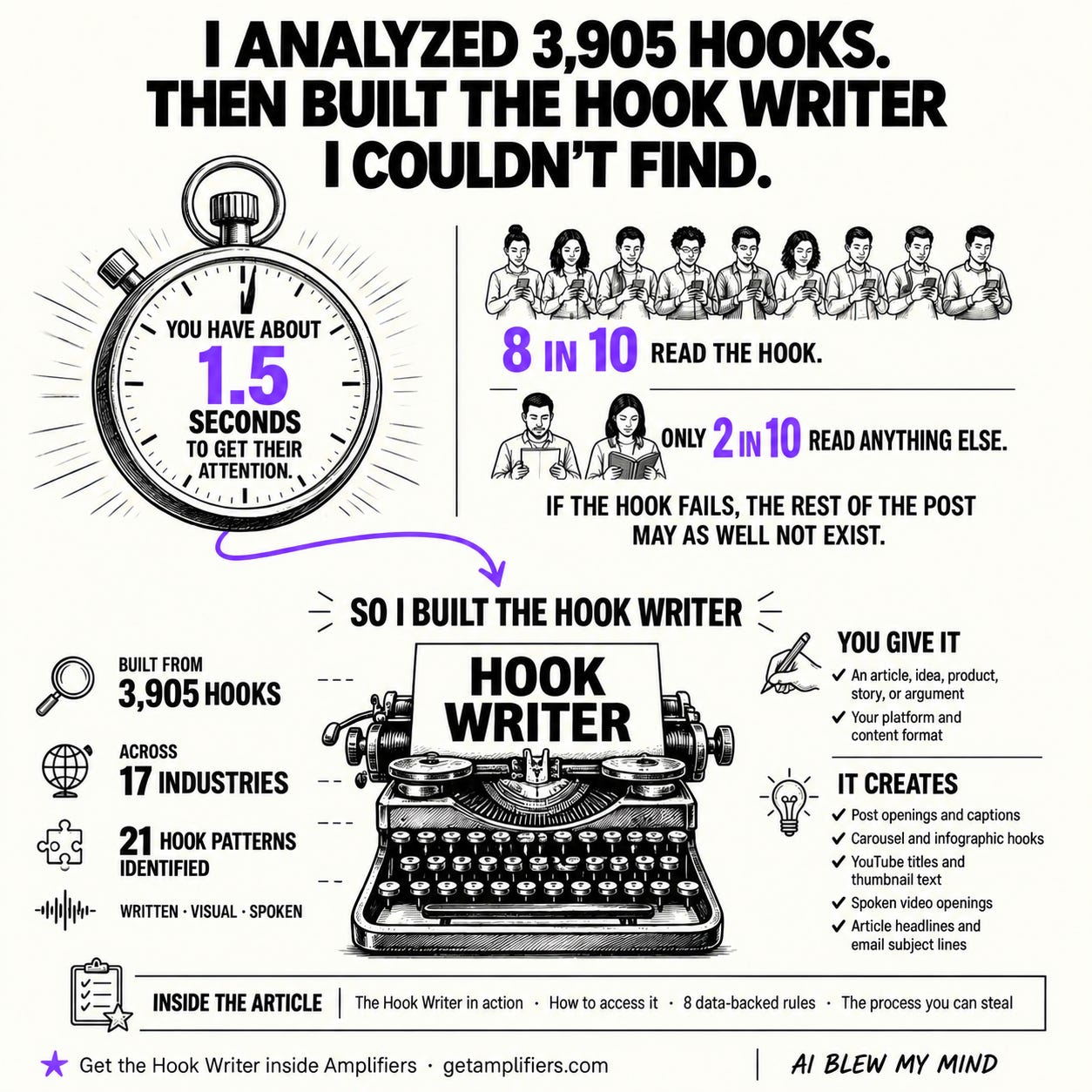
TL;DR: A hook is the first promise your content makes. It gives someone a reason to spend the next few seconds with you, and if it doesn’t grab their attention within about 1.5 seconds, they’ll scroll past.
So I analyzed 3,905 hooks from high-performing content across 17 industries and platforms including Instagram, LinkedIn, TikTok, YouTube, Threads, X, and Reddit. I found 21 recurring patterns and turned the entire library into the Hook Writer Amplifier, which creates platform-specific written, visual, and spoken hooks for whatever you want to publish, wherever you publish it.
For the past two and a half months, one of my AI agents has been collecting hooks for me.
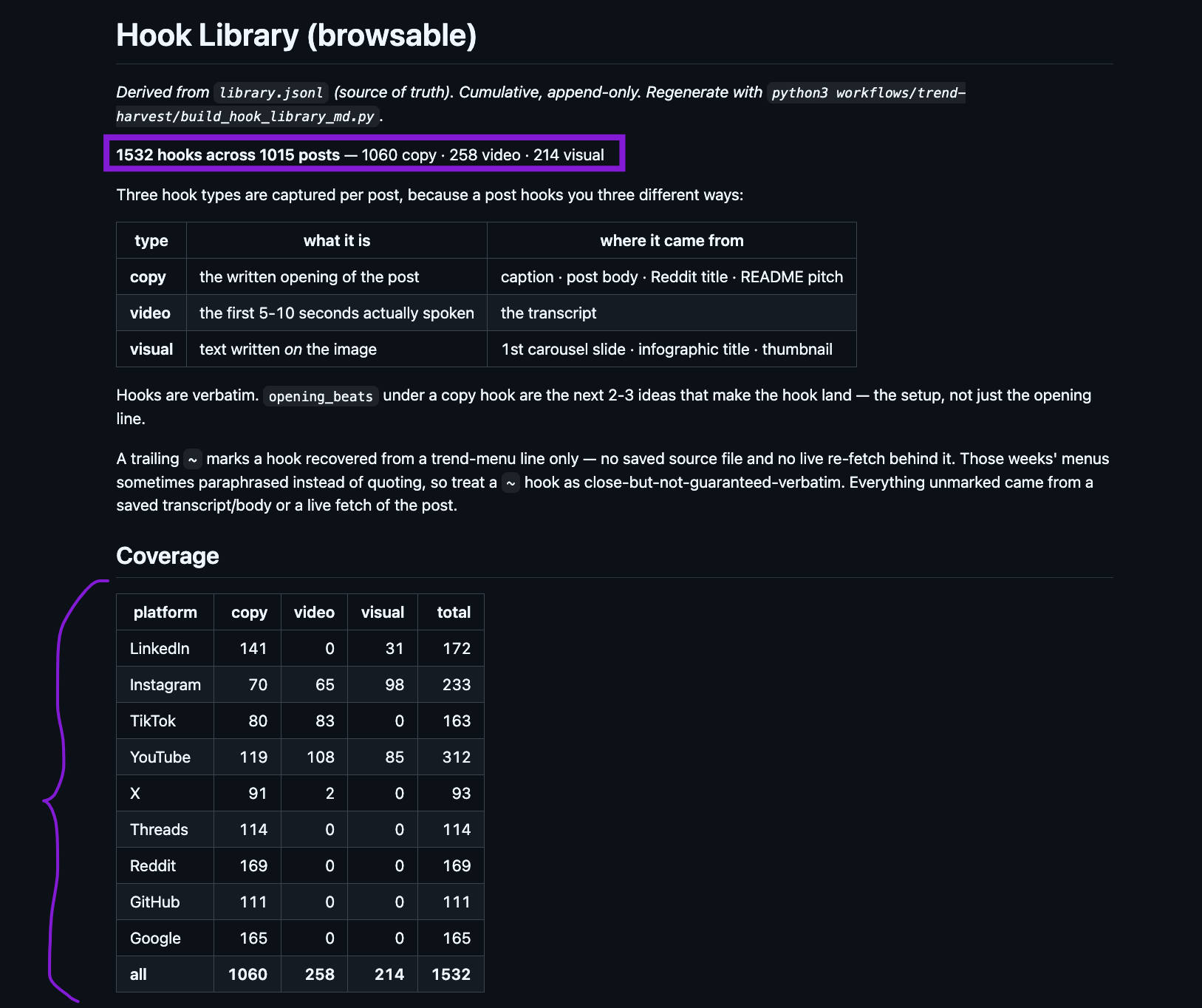
It started with the automated system I use to monitor trends in my niche. Every week, it searches for trending and high-performing content across Instagram, Facebook, Threads, X, LinkedIn, Reddit, YouTube, and Google using Amplifiers.
Then it sends the most interesting posts, videos, and articles to my Claude Code distribution agent, which helps me turn them into content for Instagram, X, LinkedIn, Threads, Facebook, and some of my Substack Notes.
But the agent doesn’t only collect the posts. It saves the hooks too.
The written opening. The text on the visual. The YouTube title. The thumbnail text. The first words spoken in a video.
By the time I stopped to look at the file properly, it contained 1,532 hooks from 1,015 posts in the AI niche.
And while I was using that swipe file to build a hook writer for my content system, I kept having the same thought: This is SO cool. I haven’t seen anyone share a hook writer built this way. With actual research and data behind it.
And look, I’ve seen plenty of hook skills and prompts online. Some give the AI formulas such as “You won’t believe…” or “The secret nobody tells you about…” Others offer a short menu of broad patterns like curiosity, storytelling, or a contrarian take.
Either way, you give the AI your topic, it picks from that little menu, swaps a few words, and hands you ten variations that sound extremely similar to the last ten hooks it wrote for someone else.
I wanted something far more ambitious.
I wanted the best Hook Writer I could build, grounded in hooks that had already appeared in viral or trending content.
One that understood the difference between a LinkedIn opening and a YouTube title. One that knew a carousel cover and its caption have separate jobs. One that could write the first sentence spoken in a video instead of pretending the caption and spoken opening are interchangeable.
But before I could share it, I had a problem: my 1,532 hooks all came from content about AI.
The Hook Writer worked brilliantly for me because it was built around my niche. But it had also learned the habits of AI content, where attention is driven by FOMO, the speed of change, and a constant stream of new launches and capabilities. No other industry in my research relied on that combination at anything close to the same level. (I checked!)
That meant I couldn’t assume those same hooks would work for someone writing about parenting, food, design, business, fitness, psychology, travel, or anything else.
So I expanded the research far beyond AI.
Once again, I used Amplifiers to gather the data, only this time I expanded the search across 16 additional industries.
After cleaning the data, I had a balanced collection of 3,905 usable hooks across 17 industries, with written, visual, and spoken hooks from different platforms and content formats.
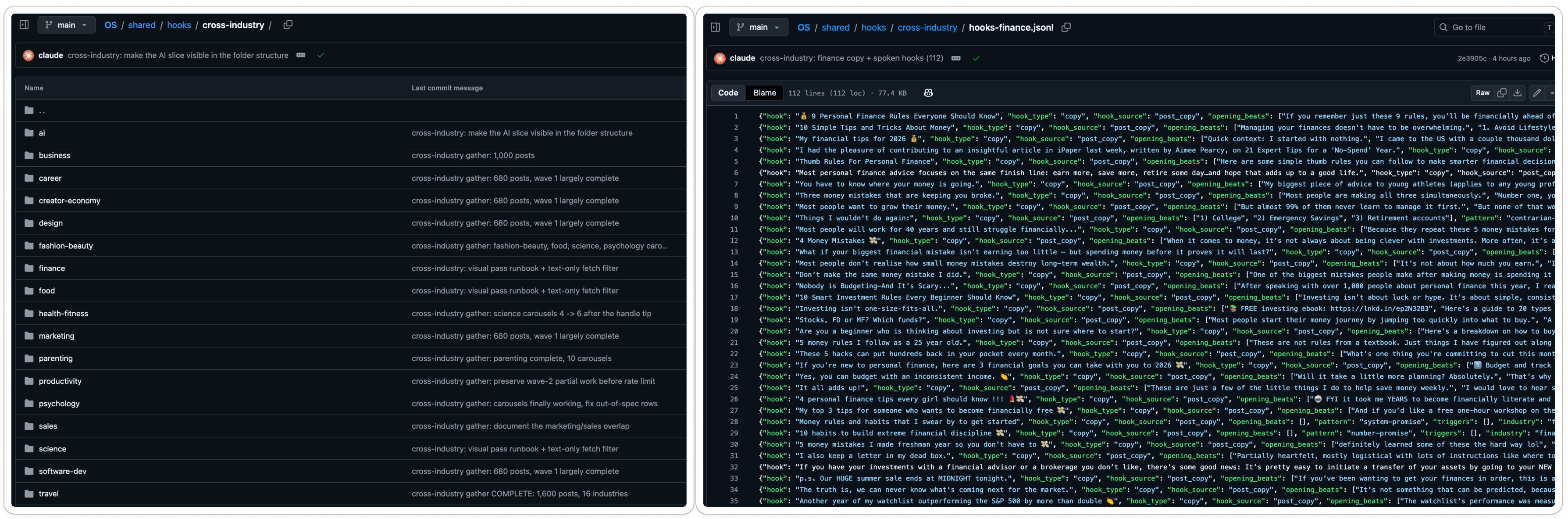
Now I finally had enough data to build something I could share with you: a Hook Writer that isn’t anchored to my niche and can adapt to:
What you write about
Where you publish it
Whether you need a caption, carousel cover, infographic title, YouTube title, thumbnail, written post, or spoken video opening
And as of today, you have access to it too.
P.S. I know I’m a day late with this article. Gathering and analyzing all this data took longer than expected because I really wanted to make the Hook Writer as good as it could possibly be before sharing it with you.
What this Hook Writer can REALLY do
I asked it to create hooks for all platforms and content formats for an HBR article about why effective leaders sometimes get branded as problems, even when the real source of friction is the company around them.
I know, it’s A LOT of hooks to read. But that is also the point. Even a quick skim will show you the breadth of what it can produce and how much thought goes into adapting each one to its platform and format.
Okay, enough blah blah. See the magic for yourself:
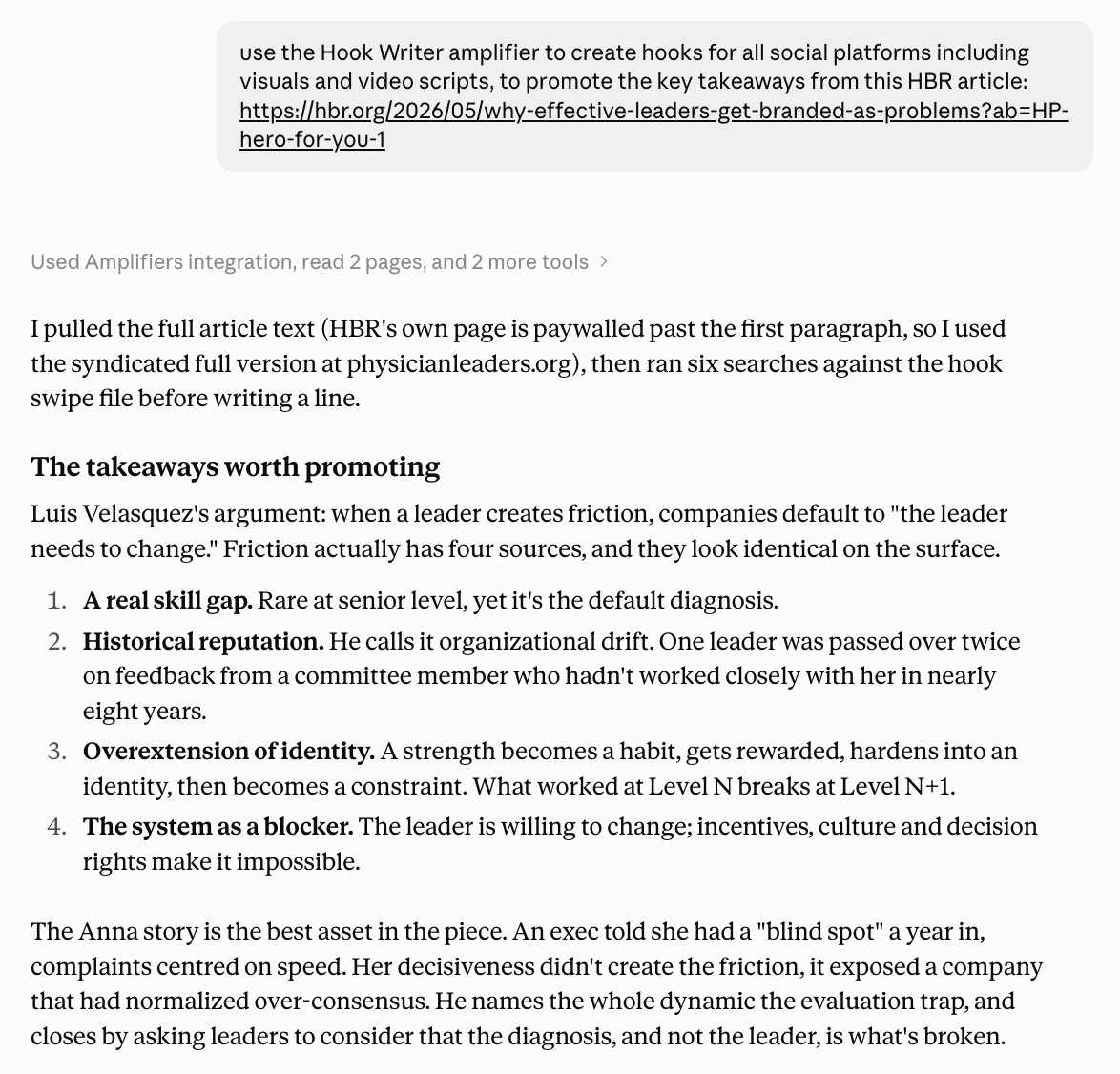
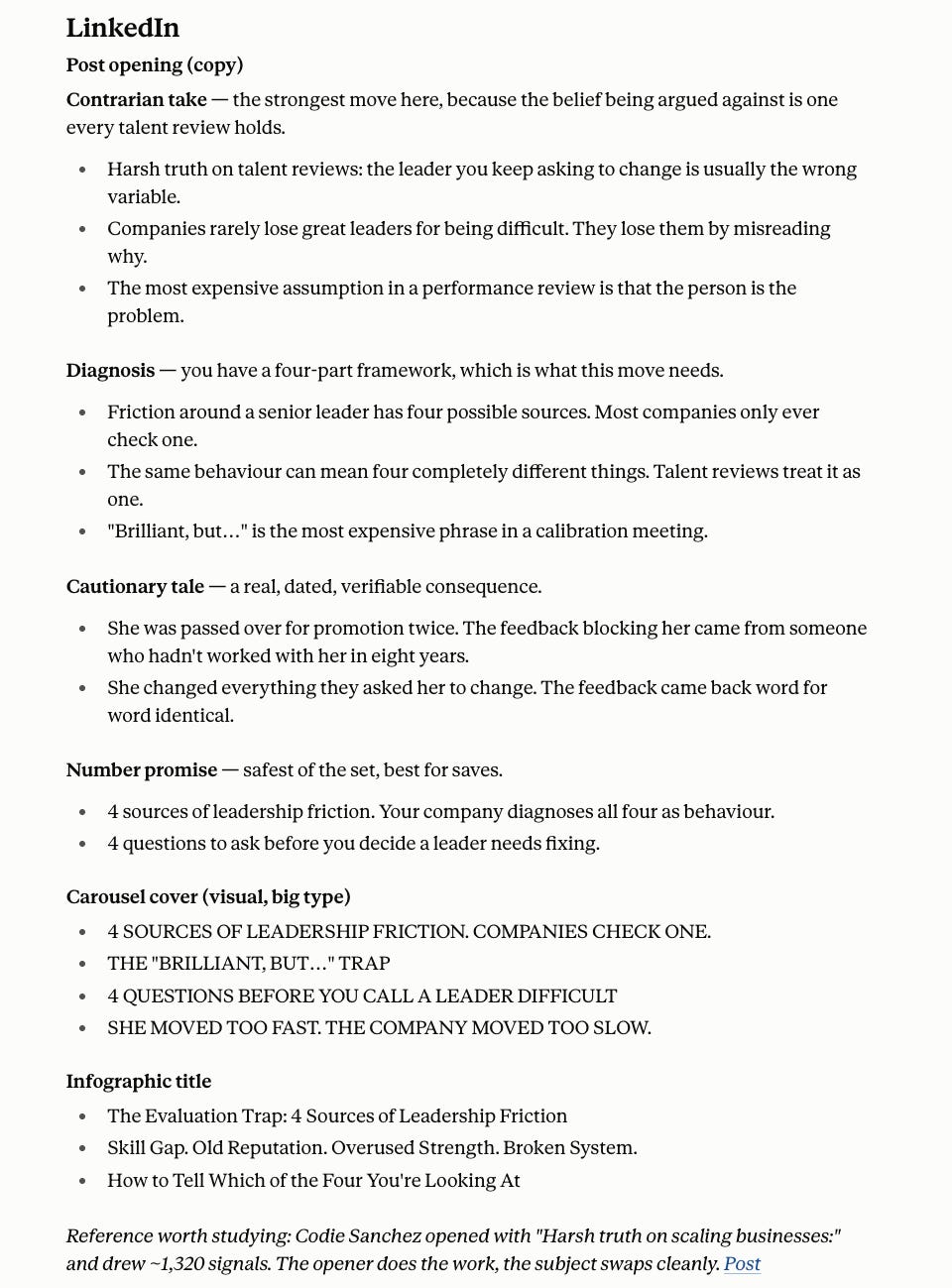
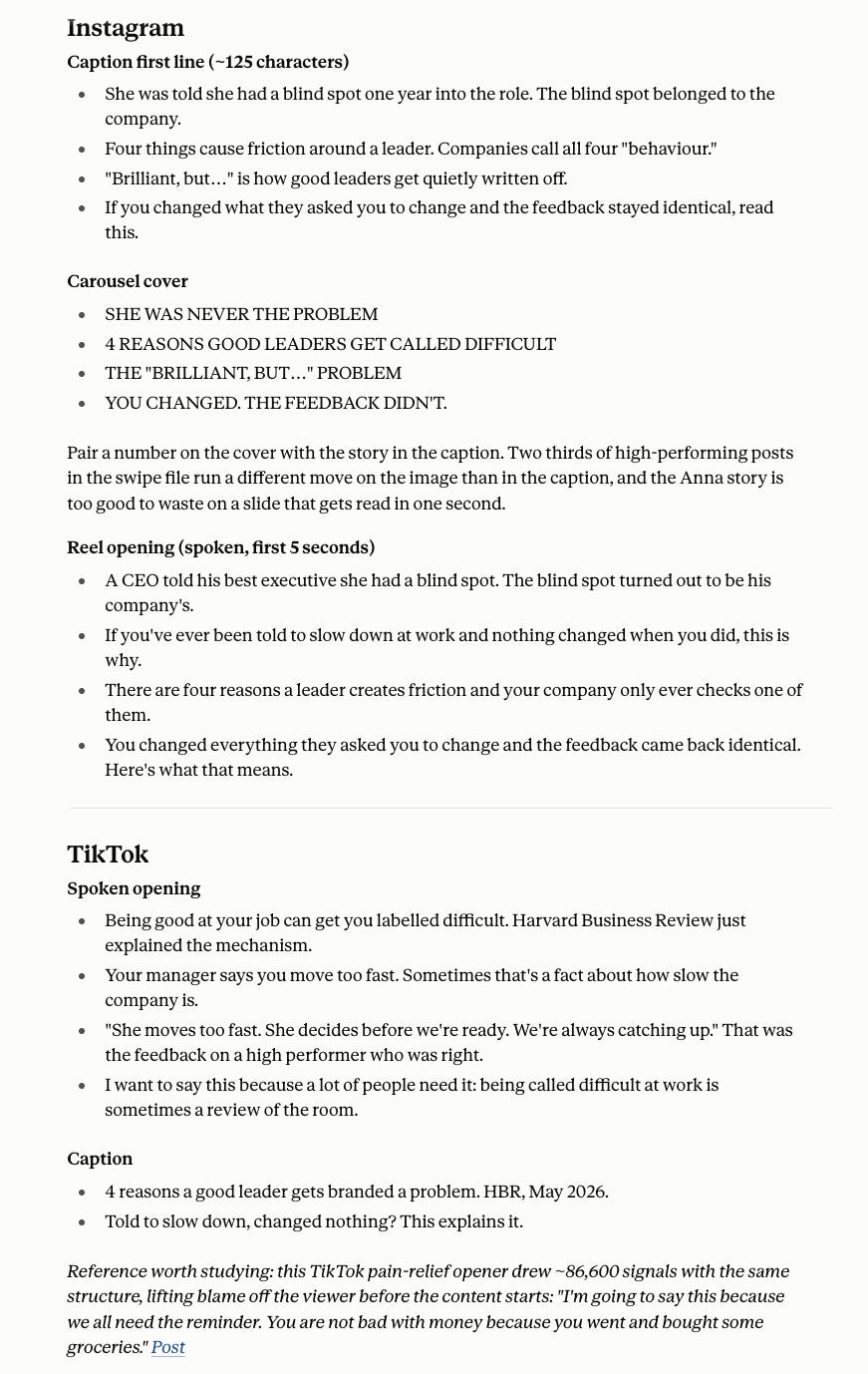
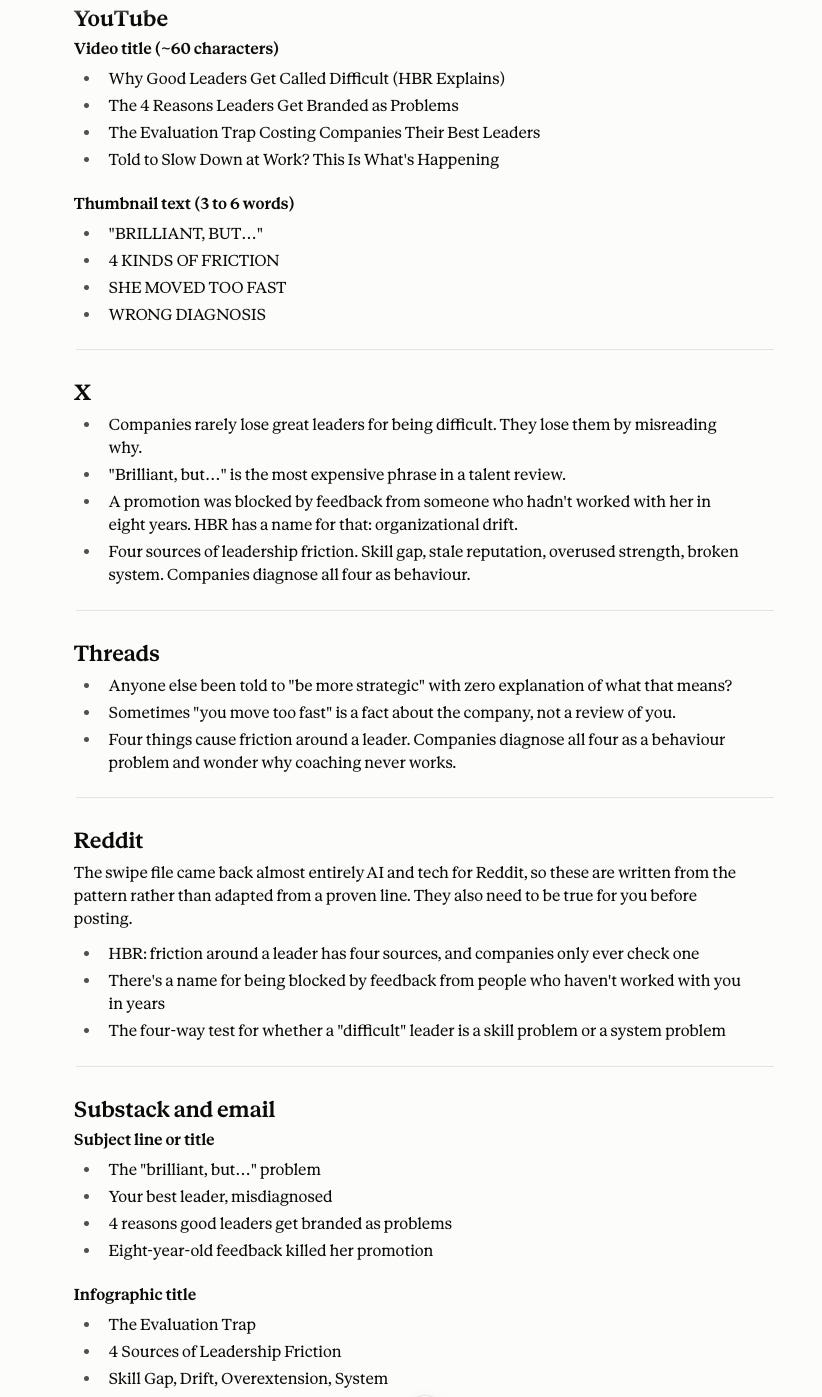
In other words, give the Hook Writer whatever you need hooks for, tell it where and how you plan to publish it, and let it do the work for you.
Then come back and tell me if it worked. Or tag me so I can see it!
How to access and use the Hook Writer Amplifier
First, follow the 2-minute Amplifiers setup guide to connect Amplifiers to your AI assistant. You only need to do this once.
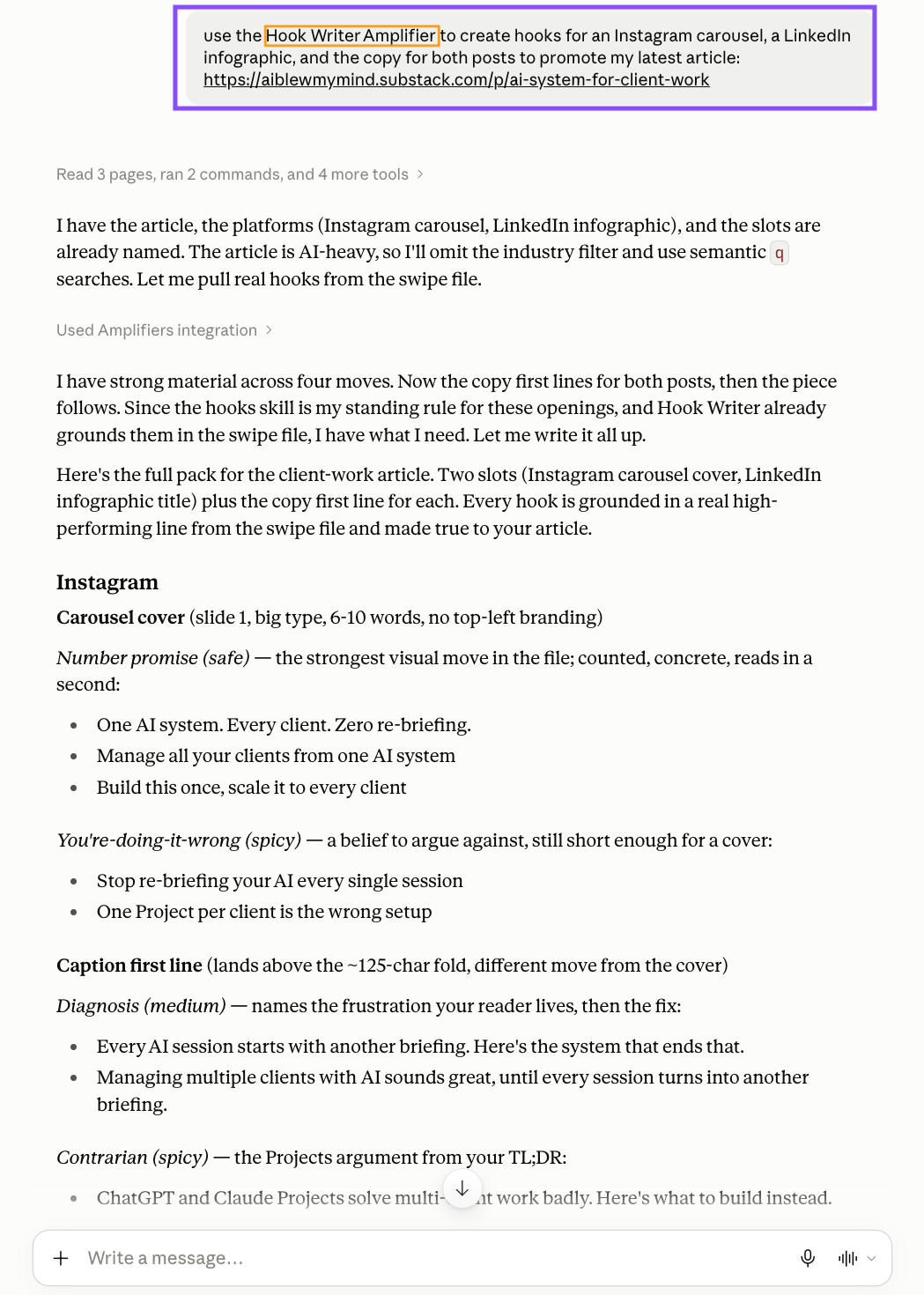
After that, whenever you need hooks, just ask your AI to use the Hook Writer Amplifier with a prompt like this:
Use the Hook Writer Amplifier to create hooks for [this].
You can phrase the request however you want. Just mention the “Hook Writer Amplifier”, tell it what you need hooks for, and give it your content or link.
You can also explore the hook swipe file yourself
This part is VERY cool too. You don’t have to use the library only through the Hook Writer. You can ask your AI to show you what’s inside:
Show me what’s inside the Hook Writer Amplifier swipe file: the industries, platforms, types of hooks it covers, etc.
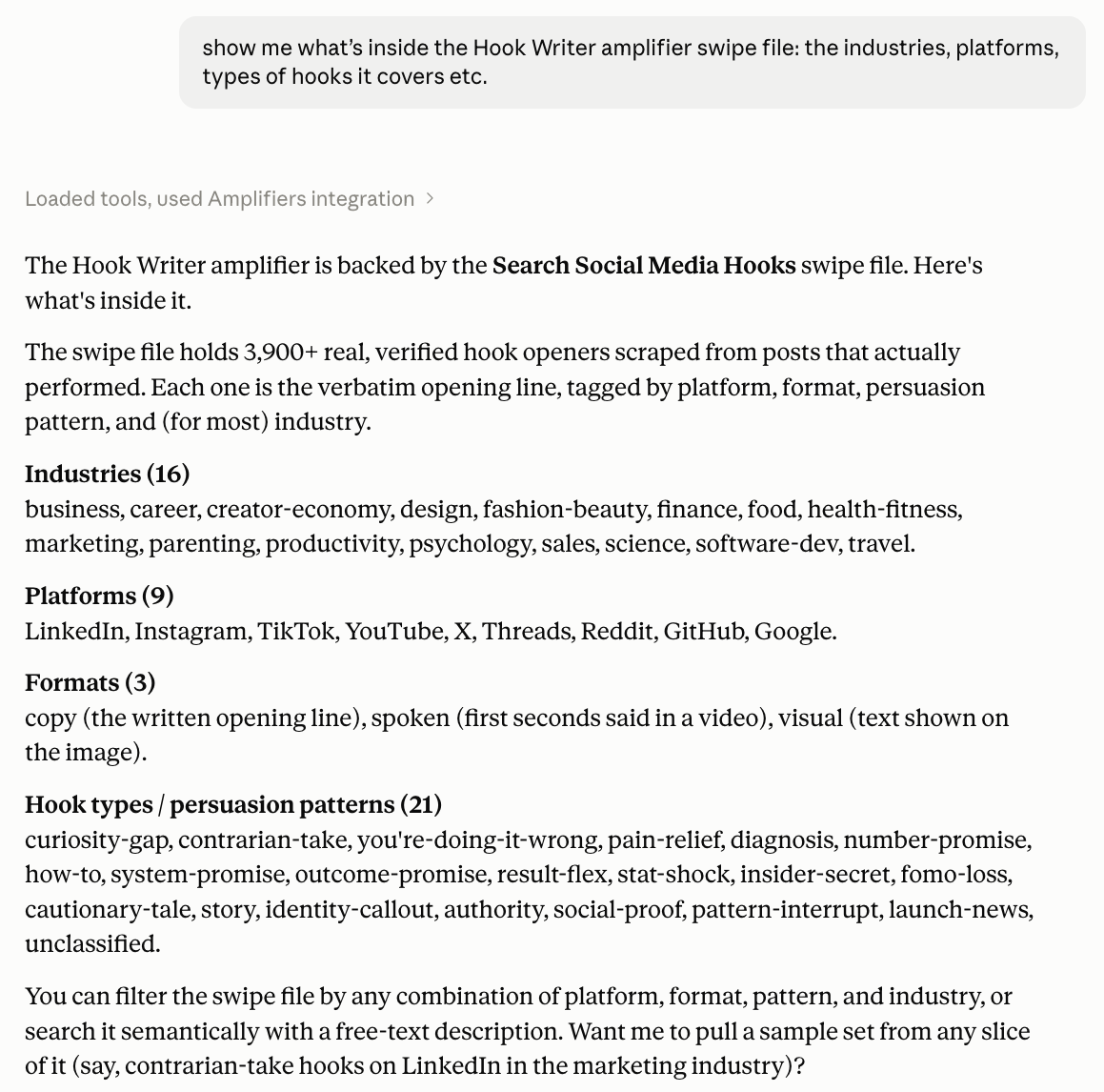
Then you can get much more specific. Ask it to pull hooks for a particular industry, platform, format, or pattern, or combine them however you want.
Here, I asked for five contrarian hooks from marketing posts on LinkedIn:
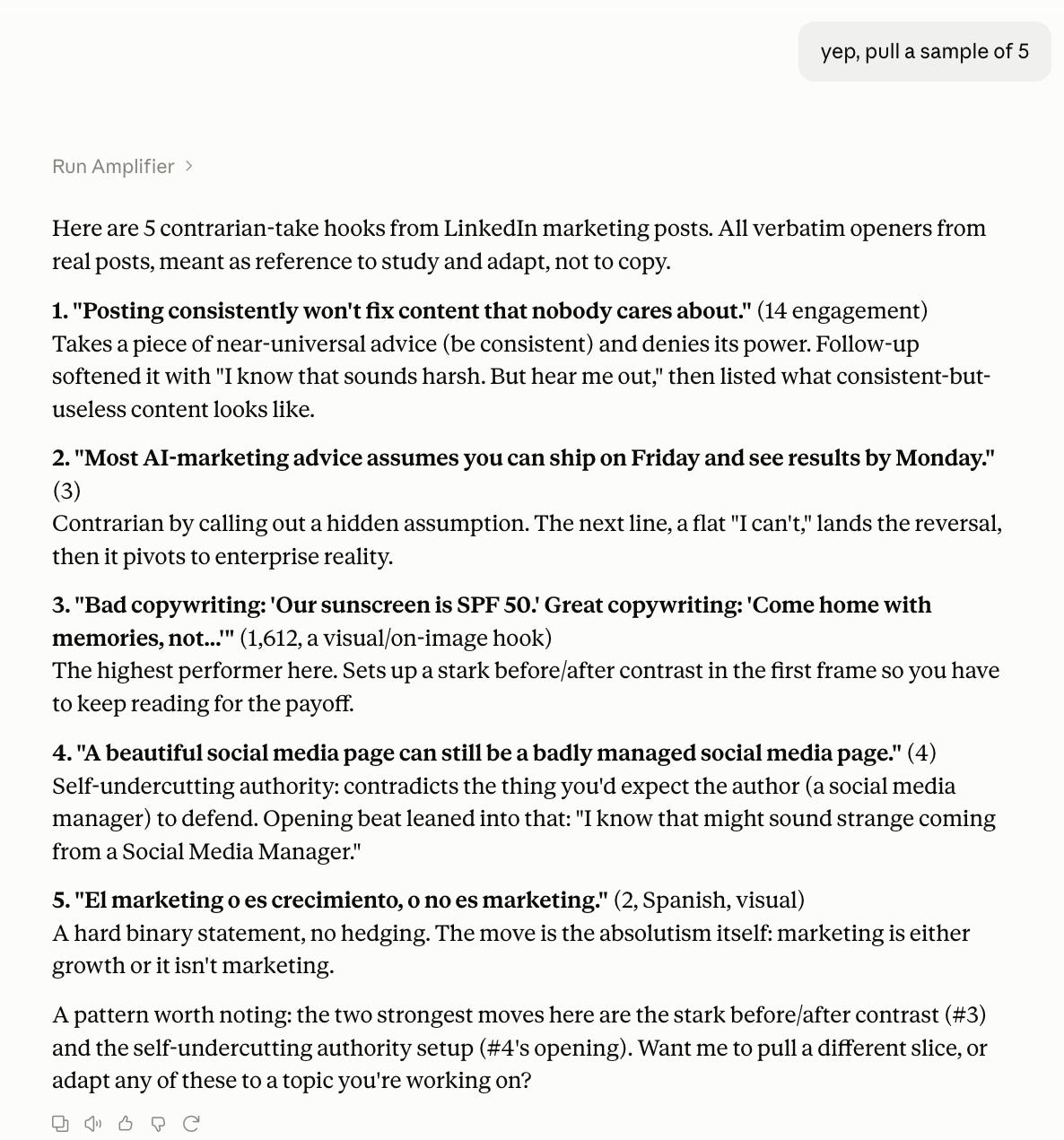
So you can use the Hook Writer to create hooks for you, or go into the swipe file yourself whenever you want examples or inspiration.
If you’re a paid AIBMM subscriber, Pro access to Amplifiers is included with your subscription. That means you already have access to the Hook Writer and every other Pro Amplifier.
8 data-backed rules for writing better social media hooks
Building the Hook Writer meant analyzing much more than which patterns appeared most often. I compared how hooks changed across industries, platforms, and formats, which moves could travel from one niche to another, and which ones only worked under very specific conditions.
The full analysis is HUGE because I needed that level of detail to decide how the Hook Writer should approach your content.
You don’t need me to drop the entire research document on you, but some of the findings are incredibly useful even when you’re writing hooks yourself. So these are the ones I think you should know:
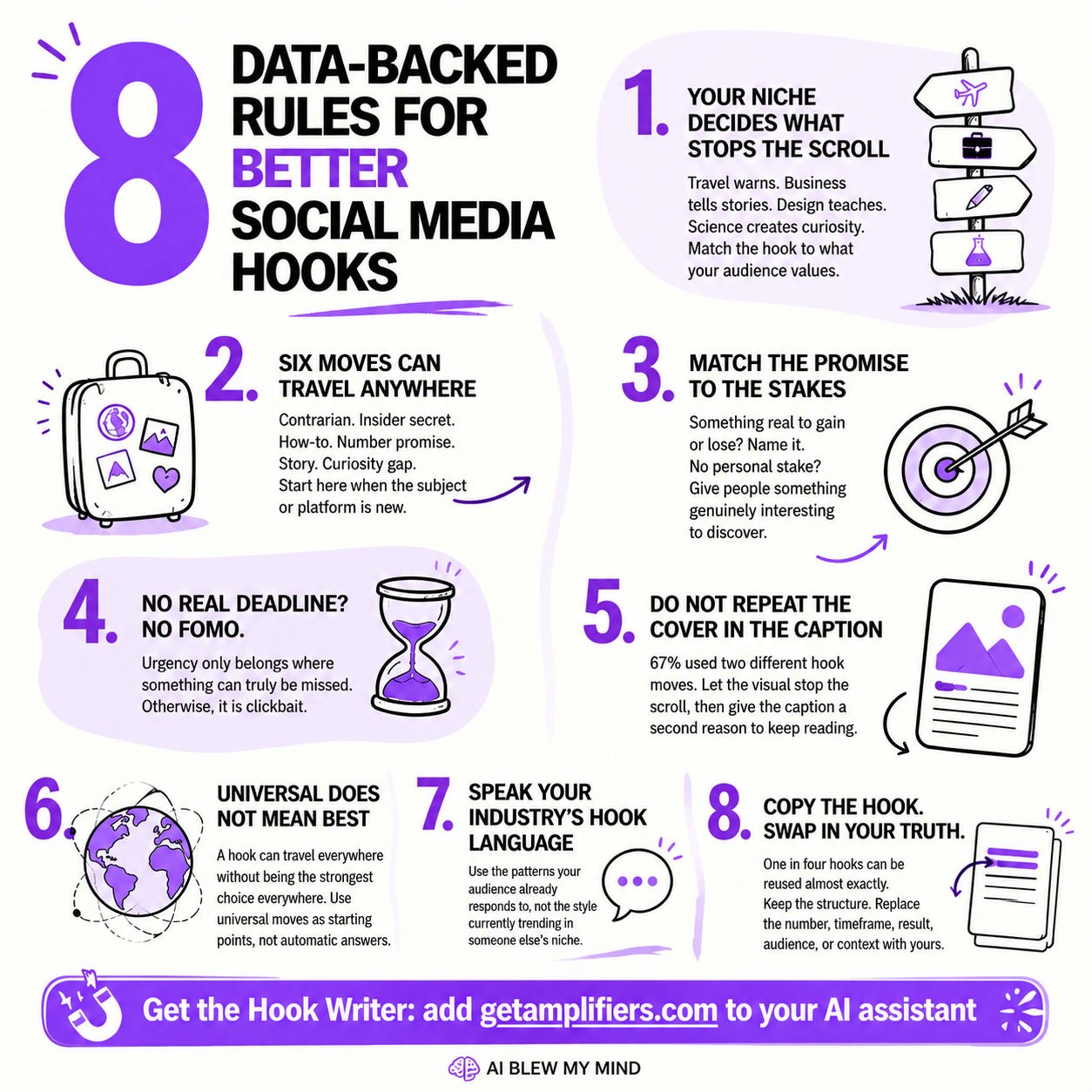
1. Stop searching for the “best” hook. It doesn’t exist.
Different industries get attention in completely different ways.
Travel and finance often lead with what could go wrong. Creator and sales content show results. Design teaches. Business tells stories. Productivity and fitness promise systems. Science creates curiosity.
So before choosing a hook, ask what your reader actually cares about in this context. Are they trying to avoid an expensive mistake? Learn how to do something? See proof? Understand something strange?
The hook should match that reason.
2. If you don’t know where to start, use one of these six
I identified 21 hook moves across the library, but only 6 appeared in all 17 industries:
Contrarian take: Challenge something people in your industry usually believe
Insider secret: Share something people feel they wouldn’t normally know
How-to: Help them complete a clear task
Number promise: Tell them exactly how much they’ll get
Story: Open with a person, moment, or situation they want to follow
Curiosity gap: Give them enough information to create a question, but not the answer
These are the safest starting points when you’re writing for a new subject or platform because they don’t need a very specific situation to work.
Every field has something to teach, a story to tell, or a common belief worth questioning.
3. The more your reader has at stake, the more you can promise
The biggest difference in the entire library came down to one question: What does the reader personally stand to gain or lose?
Hooks built around results, relief, systems, social proof, and FOMO made up:
30.5% of creator-economy hooks
26% of sales hooks
16.9% across the full library
6.2% of psychology hooks
Just 0.7% of science hooks
That is a 43x difference.
Nobody’s income depends on the age of the universe, so science cannot easily promise a result or relief from a personal problem. Instead, 40.6% of the science hooks created curiosity.
If your reader has something real at stake, name it. If they don’t, don’t invent stakes and give them something genuinely interesting to discover.
4. FOMO works. Fake urgency doesn’t.
FOMO appeared much more often in AI content than in the other industries I studied. But it can work brilliantly anywhere when there is something real to miss.
Before using it, ask yourself:
What exactly could my reader miss?
When will it happen?
Can my content prove that the risk is real?
Use FOMO when the urgency already exists. Just don’t invent urgency because you need a hook.
5. Your visual and caption shouldn’t repeat each other
I found 465 posts with both a visual hook and a caption hook. In 67% of them, the visual and caption used different moves.
They were doing two different jobs.
The visual had to stop someone scrolling, often using a short number promise or a few words that created curiosity. Once it had their attention, the caption could introduce a problem, tell a story, challenge a belief, or explain the payoff.
So don’t waste two hook slots by writing the same sentence twice. Let the visual earn the first second, then let the caption give people another reason to stay.
6. A hook can work everywhere without being the strongest anywhere
The contrarian take appeared in every industry and was the most consistent move across the library. But among the high-performing posts, its engagement ranked slightly below the typical hook for its platform and format.
Curiosity gaps were less consistent across industries, but ranked much higher.
So “universal” does not mean “best”. It means the move can travel.
Use universal moves when you have little evidence about a subject or platform. Once you understand the audience, use the patterns that fit how they actually pay attention.
7. Every industry has its own hook language
The patterns were clear enough that many industries developed a recognizable signature:
Travel and finance: Cautionary stories, because mistakes can be expensive
Creator economy and sales: Results and receipts, because success is easy to measure
Design: How-to hooks
Psychology: Number promises mixed with curiosity
Software development: Pattern interrupts
Productivity and health: Repeatable systems
Career: Authority
Parenting: Diagnosis
Business: Stories
Science: Curiosity
This doesn’t mean travel can only use cautionary stories or design can only use how-to hooks. The broader patterns still work across industries. These signatures simply show which ones each industry naturally leans toward.
So if your hook feels wrong, check whether you’re borrowing the attention language of another industry. A parenting post shouldn’t sound like an AI launch. A science video doesn’t need to promise that it will transform your life. And a sales post usually needs more than an interesting fact.
8. Copy the hook. Replace the details.
One in four hooks in the library was reusable almost exactly as written.
I found 633 copy-and-swap hooks where the structure stayed the same and only one to three details changed. That could be the number, timeframe, result, audience, or topic.
For example:
“5 mistakes keeping you from X” becomes your real number of mistakes and outcome
“How I achieved X in 30 days” becomes your result and real timeframe
“The exact system I use to X” becomes the system and outcome you can actually share
Find a hook that matches your topic, platform, and format. Keep the structure that already appeared in high-performing content, then replace the details with yours.
You don’t get extra points for inventing a completely new sentence structure. If a proven format fits what you’re saying, use it. Your originality comes from the idea, evidence, and details you put inside it.
The Hook Writer is ready for your next post
My social calendar is already full for the month, which is slightly annoying now because I can’t wait to use this hook library on my next posts and see what it changes.
This is already one of the systems I’m proudest of, right up there with the Carousel Builder, Brand Skill, Voice DNA, and many others.
Building it made me realize, once more, how big a part Amplifiers plays in everything I do as a creator. It connects my AI to real data through more than 160 tools, and I now use it for all my research, all my visuals, including the infographics in this article, and the hooks for my content too.
I really think you’re going to love the Hook Writer. Give it a try and let me know what you think.
And if you know someone who still opens a blank AI chat and asks for “ten catchy hooks”, rescue them and send them this.
Paid subscribers to AI Blew My Mind get access to all the premium workflows and tools inside Amplifiers, including the Hook Writer, plus weekly premium articles, every premium resource in the AI Blew My Mind Lab, and exclusive partner discounts. Upgrade here.
The best keeps getting better, Daria!
After your headline and subhead, nothing grabs the reader’s attention and “stops the scroll” like a great hook!
Omg! You are amazing!! I am so amazed at how you solve problems!!! Can’t wait to try this out!!