
How to Use Claude Fable 5 (Unlearn Your ChatGPT Habits)
Got good at ChatGPT prompting? Those exact habits make Claude Fable 5 worse. Here's how to prompt Fable 5 the right way — 10 tips + a free prompt optimizer.

If you got good at ChatGPT over the last two years, you built a set of habits.
You learned to spell everything out. Break the task into steps. Add rules so it wouldn’t go sideways. Tell it what not to do.
Those habits worked. They’re the reason you got decent results while everyone else typed “write me a blog post” and got mush.
Now those same habits make Fable 5 worse. It’s in Anthropic’s own prompting guide:

Older models needed the rails. If you didn’t spell out every step, the model wandered off. Fable 5 doesn’t need that. Over-constrain it and you box in the judgment that makes it good.
This guide is about unlearning those habits so you can work well with Fable 5. It’s back on subscriptions only through July 12.
To save you the slow part, I also built two free tools in the Amplifiers library:
a Fable 5 prompt optimizer that rewrites any prompt you already use into one Fable handles well,
and a matching Sonnet 5 optimizer for the other model that launched the same week.
Start with the Fable one on your most-used prompt. It's the fastest way to see what everything below is talking about. Here’s an example:
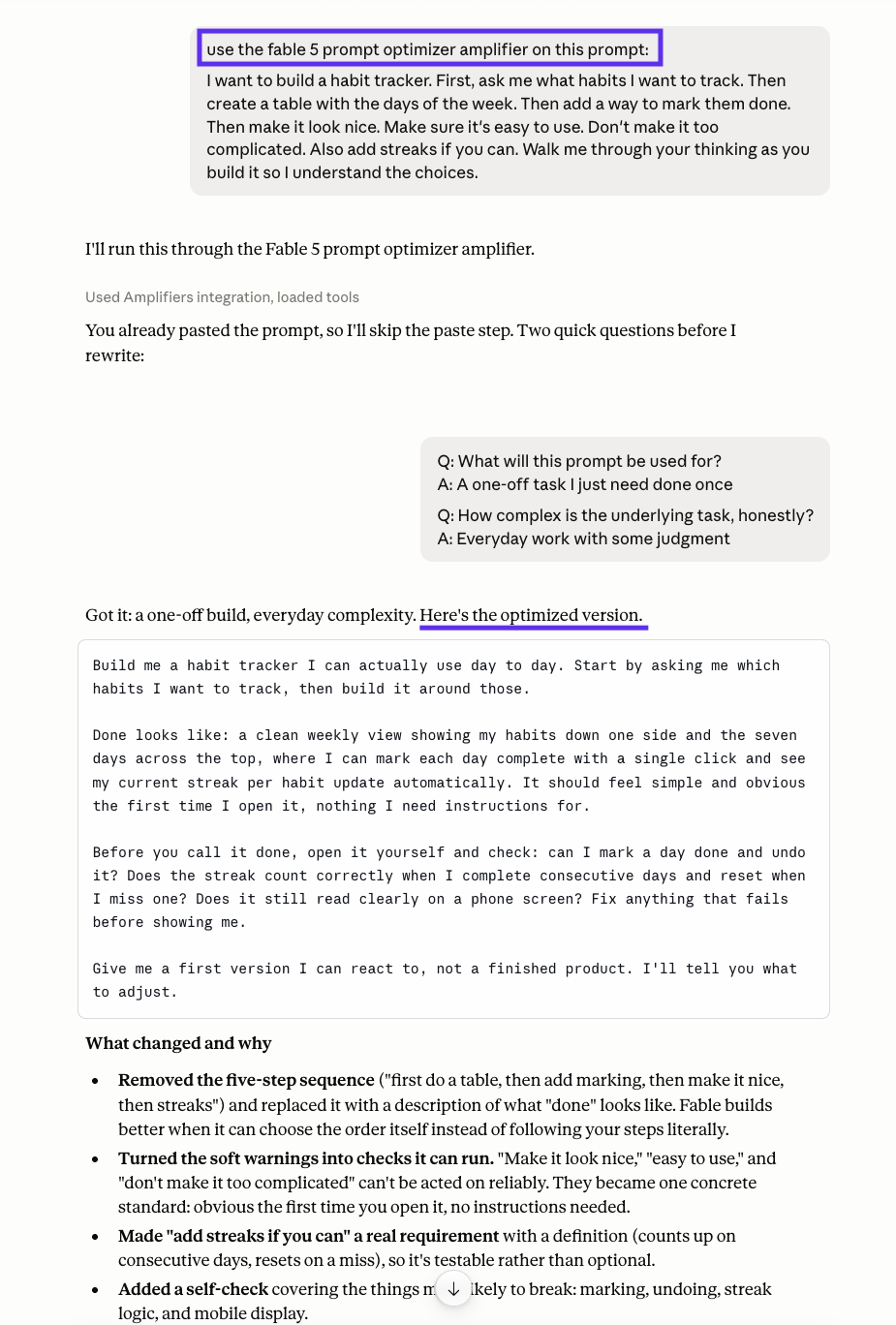
Update (July 8): Good news — Anthropic just extended free Fable 5 access on all paid plans through July 12. You’ve got five extra days inside your subscription to practice everything below. Original deadline was July 7.

Here’s what we’ll cover:
Why your ChatGPT habits make Claude Fable 5 worse
Claude Fable 5 is back on subscriptions (only until July 12)
Claude Fable 5 is back on subscriptions (but only until July 12)
Fable launched June 9, got pulled a few days later under a US export control directive, and came back July 1 once the controls lifted. I covered that saga, and what people built in Fable’s first window, in my last piece.
What matters now is the access window:
Through July 12, if you’re on Pro, Max, Team, or premium Enterprise, Fable is included for up to 50% of your weekly usage limits. Applied automatically, nothing to opt into.
Once you hit that 50%, Fable stops drawing from your plan. You either pay for it through usage credits or spend the rest of your week on the cheaper models.
The cutoff is 11:59pm Pacific on July 12. After that, Fable is credits-only, billed separately from your subscription.
One thing to plan around: Anthropic says Fable burns your weekly limit faster than any other Claude model. Your 50% won’t stretch as far as a normal week’s usage.
Fable isn’t gone after July 12. A Claude Code lead said Anthropic wants to bring it back to subscriptions once capacity catches up with demand. For now, this is the cheapest Fable will be for a while, so use it on something that matters.
Claude Fable 5 vs Sonnet 5: same generation, opposite prompting rules

Fable wasn’t the only model that launched this cycle. Sonnet 5 dropped alongside it, and if you’ve seen both, you’ve probably wondered how they relate. Two models, same “5”, clearly connected somehow.
Both are part of the Claude 5 generation, at opposite ends. Sonnet 5 is the fast everyday model. Fable 5 is the most capable one Anthropic has released publicly, in a new top tier called Mythos-class that sits above Opus.
They’re built for different jobs, so they need opposite prompting. If you use both, this is worth a minute.
What they share
Three habits work on both:
Load your context upfront. Give the full picture in your first message instead of dripping it out over a back-and-forth.
Use the effort dial. Reach for it instead of re-prompting when the answer comes back shallow.
Drop the old scaffolding. The forced check-ins, the over-cautious rules, the reminders you added because older models needed them, all of it can go.
Where they differ
The takeaway: With Fable, say what you want and trust it. With Sonnet, say exactly what you want and leave nothing implied.
Now, back to Fable, everything from here is about getting the most out of it.
How to prompt Claude Fable 5: stop giving it tasks, start giving it responsibilities
There’s one mental shift underneath everything that follows, and Felix Rieseberg, who leads Claude Code at Anthropic, put it this way: the move from giving AI tasks to giving it responsibilities.

A task is a step. “Summarize this. Now reformat it. Now shorten it.”
A responsibility is an outcome you trust someone (or something) to figure out. “Turn this into a board update they can skim in two minutes.”
Every tip below is that same idea applied in a different place. You’ll stop describing the steps and start describing the destination.
10 ways to use Claude Fable 5 better (with examples)
Everything above is the why. These are the moves that change how your work comes out.
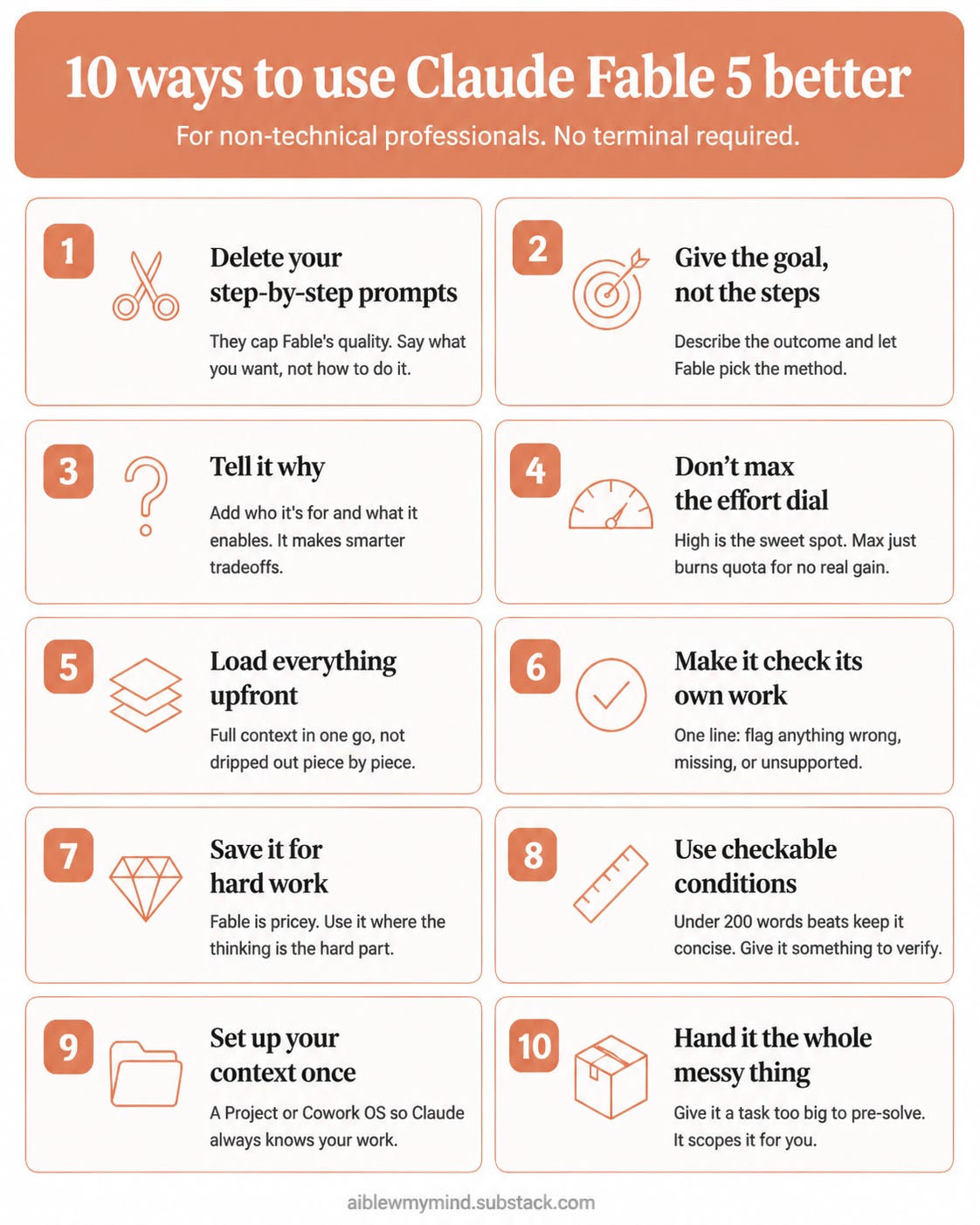
Tip 1: Delete your prescriptive prompts
The move: If you’ve saved prompts that walk Claude through a process step by step, “First do X. Then do Y. Make sure to Z. Never do W”, start by rewriting those.
Why it works: Those prompts were built for a model that needed the hand-holding. Fable 5 finds them limiting the same way a senior colleague would feel stifled if you narrated every step of a job they’ve done hundreds of times.
You don’t have to throw away the knowledge inside those prompts. You need to reframe it. Instead of “do these steps”, say “here’s what I’m trying to accomplish, here’s the context, here’s what done looks like.” The process is Fable’s to figure out.
Tip 2: Give it the goal, not the steps
The move: Stop describing a process. Describe an outcome.
Why it works: The second version hands over the goal and trusts Fable to pick the method. That’s where the speed comes from.
Old way: "Look at my bank transactions. Categorize them. Add up each category. Make a table. Then tell me where I'm overspending."
Fable 5 way: "Here's a year of my bank transactions. Build me something that shows where my money goes and tells me what to cut to hit my savings goal. Figure out the best way to show it."
Tip 3: Tell it why, not just what
The move: Give Fable the reason behind the request, not just the request.
Why it works: When it knows why you need something, it makes smart tradeoffs you never had to spell out.
“I’m working on [larger task] for [who it’s for]. They need [what the output enables]. With that in mind: [request].”
In practice:
“I’m deciding whether to raise prices next quarter. Here’s my pricing, my costs, and the last year of sales. Work out whether a raise makes sense, what it would do to demand based on what you see in the data, and where the risk is. I need to defend this decision to my co-founder.”
Without the reason, it runs the numbers and gives you an answer. With it, it builds the case the way you’d need to defend it, weighing the tradeoffs your co-founder will push on.
Tip 4: Use the effort dial, but don’t default to max
The move: Start on high. Drop to medium for simple work. Save max for the hard problems.
Why it works: Lower effort settings on Fable still perform well and often beat the highest settings on older models, so cranking to max mostly just burns quota.
Fable 5 has an effort setting, the “Thinking” toggle in Claude.ai. Here’s how the levels behave:
Medium: handles everyday tasks and is more capable than you’d expect
High: the sweet spot for almost everything
Max (extended): spawns dozens of internal reasoning chains, burns quota fast, and for most tasks doesn’t come back meaningfully better
Fable 5 on medium already clears the bar for most of what you do in a day. Reach for max only when high isn’t cutting it.
Tip 5: Load the full context upfront, then let it run
The move: Give Fable everything it needs at the start, not in pieces.
Why it works: It makes better judgment calls when it can see the whole picture at once. Feed it piecemeal and it optimizes for the fragment in front of it, then has to backtrack when the next piece changes the picture. Feed it everything and it plans around the real shape of the task from the first move.
What counts as rich context:
The actual files or data, not a description of them
The real constraint (budget, format, audience, deadline)
What “done” looks like
What matters most versus what’s flexible
What doesn’t help: piles of caveats, step-by-step instructions, or the slow back-and-forth you might be used to have with other tools, dripping in one piece at a time.
Tip 6: Make it verify its own work
The move: Add one line that tells Fable to check its own output before handing it to you.
Why it works: When Anthropic asked their team for the single most impactful prompting tip, the answer was verification. If you adopt one habit from this whole guide, make it this one.
It can be as simple as one line at the end of your prompt:
“Before you call this done, check it against what I asked for and flag anything that’s wrong, missing, or unsupported.”
That one instruction catches most mistakes before they reach you.
Tip 7: Save Fable for the work that’s actually hard
The move: Use Fable for your biggest, most complex projects. Use a cheaper model for everything else.
Why it works: Fable is the most expensive model Anthropic makes, five times Sonnet 5’s rate and double Opus 4.8. Its advantage only shows up on long, complex, multi-step work. On simple tasks, you’re paying a premium for a lead that isn’t there.
The simplest way to tell the difference: is the answer already sitting there or does it have to be worked out?
Fable for the work that has to be worked out: a big project with lots of moving parts, a problem with no obvious right answer, anything where getting it wrong is expensive.
Sonnet or a different model for the work that’s already clear: quick questions, drafting, reformatting, summaries, anything with a straightforward answer.
Tip 8: Use observable conditions, not soft warnings
The move: Replace vague instructions with concrete conditions Fable can check itself against.
Why it works: “Be careful” or “don’t be too detailed” are hard for any model to act on. A checkable condition isn’t.
The swaps look like this:
Instead of “make sure it’s accurate”
Try “flag any claim you can’t directly support from the documents I gave you”
You’re not adding guardrails. You’re giving it something it can verify against.
Tip 9: Set up your context once, reuse it everywhere
The move: Save your context somewhere Claude reads automatically, so every session starts already knowing your work.
Why it works: Instead of briefing Claude from scratch each time, it opens already caught up on what matters.
The simple version is a Claude Project: one area of your work, with instructions Claude reads at the start of every chat inside it. Good for a recurring task like weekly reports or client updates.
The better version is a Cowork operating system. A Project holds context for one thing. The OS holds all of it and routes between areas on its own, so you can ask for anything and it pulls the right context and skills without being told which. I run my whole business out of mine and never brief it from scratch.
Either way, the habit is the same: write your context down once, and add a line whenever Claude learns something useful about how you work.
Tip 10: Hand it the whole thing, even when it feels too big
The move: Give Fable a task bigger than you’d normally trust a model with, and let it break the task down instead of doing that yourself.
Why it works: With older models you had to chop a big job into small pieces or it would choke. Fable is built for the opposite. Anthropic’s own advice is to hand it something harder than you’d give any previous model, and let it scope the work, ask you what it needs, and run.
So instead of pre-solving the structure, describe the whole messy thing: “Here’s everything I know about this problem, here’s what I’m trying to get to, figure out how to get there and tell me what you need from me.”
Free Claude Fable 5 and Sonnet 5 prompt optimizers you can run inside Claude
I built two free tools that do the rewriting for you, right inside your Claude chat. Both live in Amplifiers, and they take any prompt you already use and rebuild it for the model you’re on, Fable or Sonnet.
The Fable 5 prompt optimizer is the shortcut for everything in this guide. Paste a prompt you already lean on, a saved ChatGPT-era one is a perfect candidate, and it rewrites it Fable’s way, then shows you the before and after. The gap between what you had and what it gives back is your personal unlearn list.
The Sonnet 5 prompt optimizer does the opposite treatment for the faster model: more explicit, tighter scope, nothing left implied. Same flow, a few seconds to run.
How to use them
If you’ve never touched Amplifiers, setup takes under a minute. Connect it once.
After that, you just ask in plain English:
“Optimize this prompt for Fable 5 using an Amplifier”
“Optimize this prompt for Sonnet 5 using an Amplifier”
That’s it.
Now go try it with one of your most-used prompts and see how the Fable and Sonnet versions differ. And if you’re looking for ideas on what to use it for, read this guide first:

What have you made with Fable 5, or what do you want to try it on? And if you’ve used Sonnet 5, what do you think of it?
And if the optimizers or anything here helped, I’d really appreciate you sharing it. That’s how this newsletter grows, one person passing it to another.
This post is free, but to get access to all premium workflows and tools inside Amplifiers, weekly premium articles, all premium resources inside the AI blew my mind Lab, and exclusive partner discounts, consider upgrading your subscription.
Great work, Daria! I was wondering if medium was fine for Fable so thanks for verifying it.
This is an excellent guide, especially how you point out how counterintuitive it can be. Very well done.