

We launched Amplifiers four months ago. Since then, more than 2,000 people have started using it, and the catalog has grown to around 300 workflows, prompts, and tools.
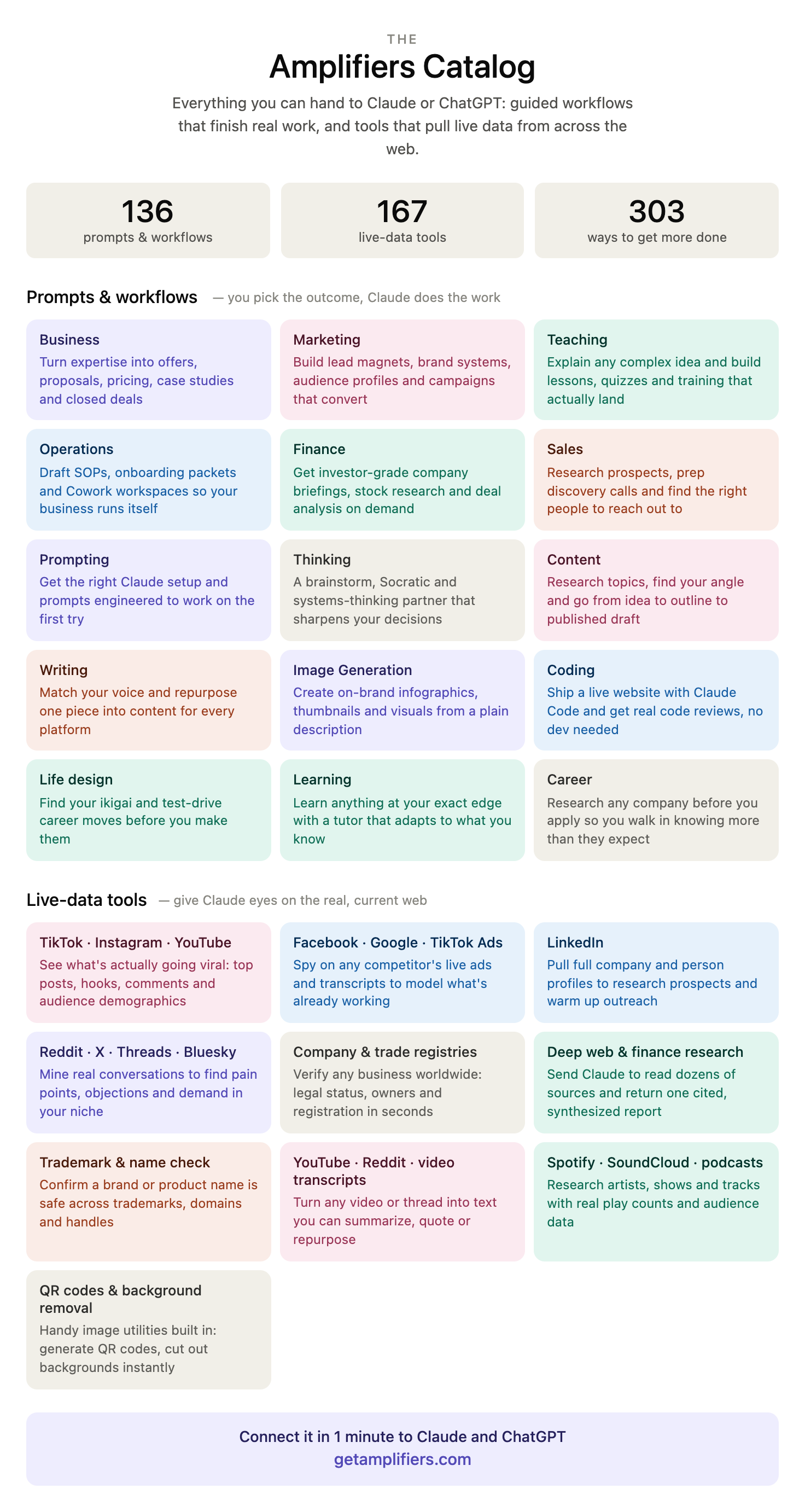
For me, Amplifiers has become as indispensable in my work as AI itself.
I can start with “I need to research this person,” “I need reliable data for this article,” or “I need to turn this idea into a campaign,” and there is an Amplifier ready to help.
That means I can go straight from needing something to working on it. It is like having a team of specialists I can pull in instantly. Things I simply could not do before are now possible, and the work I was already doing gets done much faster and comes out better.
That feeling is incredibly empowering.
I know this might sound biased because I built it. But I also built another startup before this one, and I didn’t use that product myself. I know the difference between loving something for its mission and loving it because your life would be much harder without it.
That is why it felt so strange to understand Amplifiers this well as a user, get so much value from it every day, and still struggle to explain it clearly as its creator.
Whenever someone asked what it was, I would reach for the machinery: MCPs, workflows, tools, live data, research, expertise. I was explaining what was inside before giving you a simple way to understand the whole thing. Some of you even told me it was confusing or that you could never remember everything Amplifiers included.
You never needed to remember it all. I simply had not found a clear way to explain what everything inside Amplifiers added up to.
This week, that changed. I spent 70 minutes with Rich Carr and the Clarity Map, an AI-free visual thinking tool based on a framework he developed to help you turn everything you know into one thing your audience will remember.
That was exactly what I needed: to find a clearer way to position Amplifiers, so someone hearing about it for the first time could understand it.
So let me introduce you to Amplifiers again, this time through what it makes possible. I’ll show you why it has become so indispensable to my work, how I make the most of it, and how other people are using it in completely different ways.
The advantage Amplifiers gives me that feels a little like cheating
You have no idea how many times my business partner and I have finished a conversation and wished we had recorded it.
I would be telling him about the latest thing Amplifiers had helped me pull off, with an excitement I never seem to capture when I sit down to explain the product properly.
Those conversations may have explained Amplifiers better than any description could because they always came back to the same thing: look what I can do now and look how quickly I managed to do it. That is why using Amplifiers so often feels like cheating.
And then there is everything I no longer have to find, learn, connect, and pay for, because trying to build the same setup myself would cost me in so many ways:
Time: It cuts hours from every stage of my work, from research and planning to creation and delivery. I don’t have to search across a million tabs, piece everything together myself, or spend days building an agent or automation that only works for one version of the task.
$$$ every month: I would need separate services for research, pulling data from social platforms, running automations, and who knows how many tools I might pay for only to use once. For everything I use Amplifiers for, that could easily cost me hundreds per month.
Technical setup: Building all these agents and automations myself would take technical knowledge and a lot of troubleshooting. With Amplifiers, I get the result without having to deal with those technical headaches.
Learning curves: Every separate tool would come with its own interface and way of working. Here, I stay inside the AI I already use. All I have to do is ask it to use an Amplifier, and it pulls in the extra capability it needs to give me a better result.
This is why I get so excited about it. I can easily see what it could do for your work because I experience the advantage it gives me in mine every day.
By the way, if you’re a paid AI Blew My Mind subscriber, Amplifiers Pro is already included, with access to everything inside. It takes about a minute to connect it to your AI. After that, you can instantly plug in expert backup for whatever your work needs, whenever you need it.
Now… The best way to show you why it has become so indispensable to me is through one of the main parts of my work: creating content.
The team I now have behind every article and the media brand I’m building
A lot of my work is content, and Amplifiers is there before, during, and after everything I publish. As the work moves from one stage to the next, I can plug a different kind of specialist into the same AI.
Before I decide what to write, automated systems and AI agents built on Amplifiers act as my trend researchers. Every week, they scan trends, keep up with the news, track what the big AI companies are releasing, and follow conversations across Google, YouTube, Reddit, LinkedIn, X, Instagram, TikTok, and Facebook.
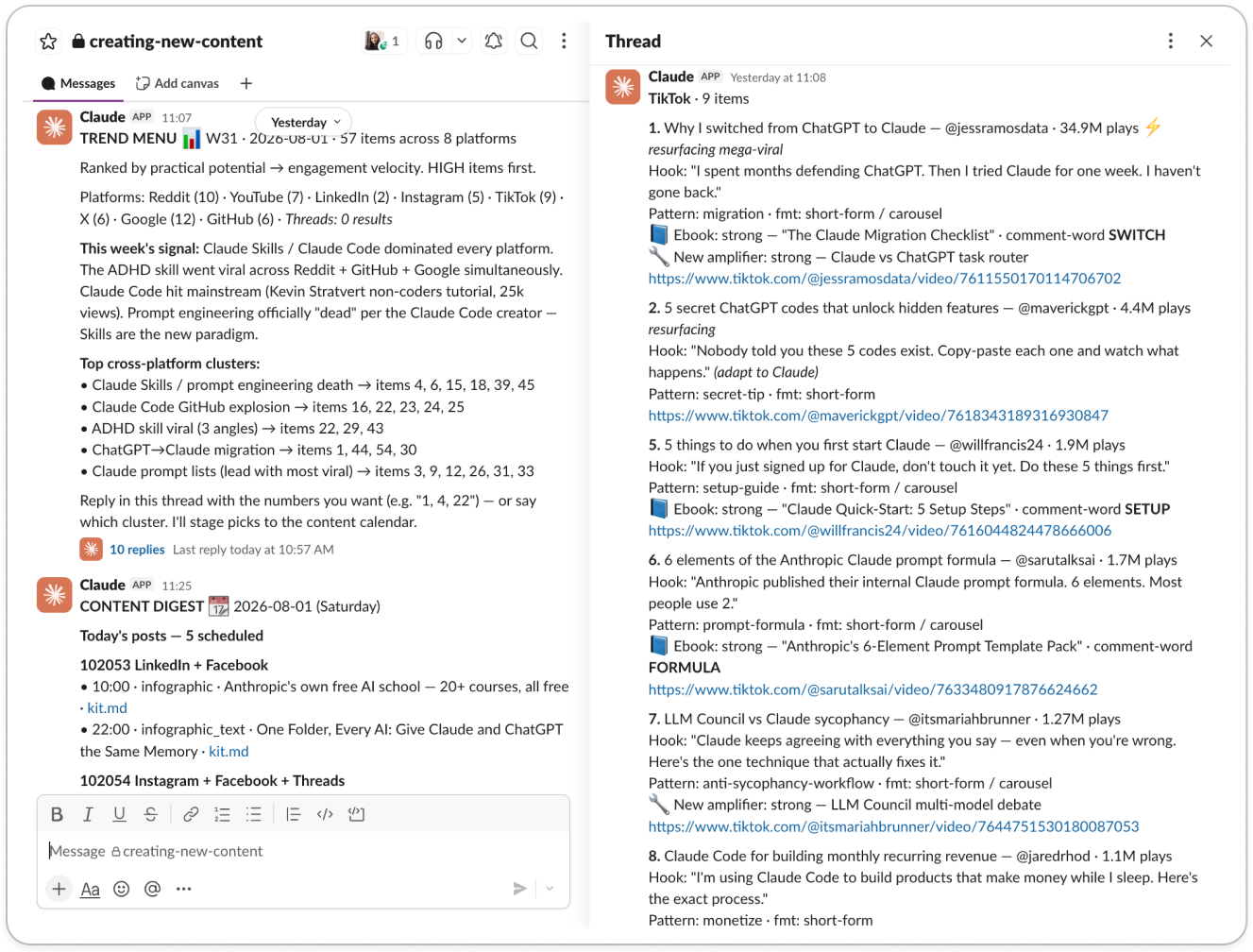
I could never keep up with all of that myself and still have time to create anything. But in my role, staying on top of what is happening across the industry is part of the job because it shapes what I decide to publish.
Once I choose a topic, the Topic Research Amplifier steps in. It searches current sources to show me what has already been published, what people are asking, the language they use, and where I might still have something useful to add. It also gives me links I can open and check myself.
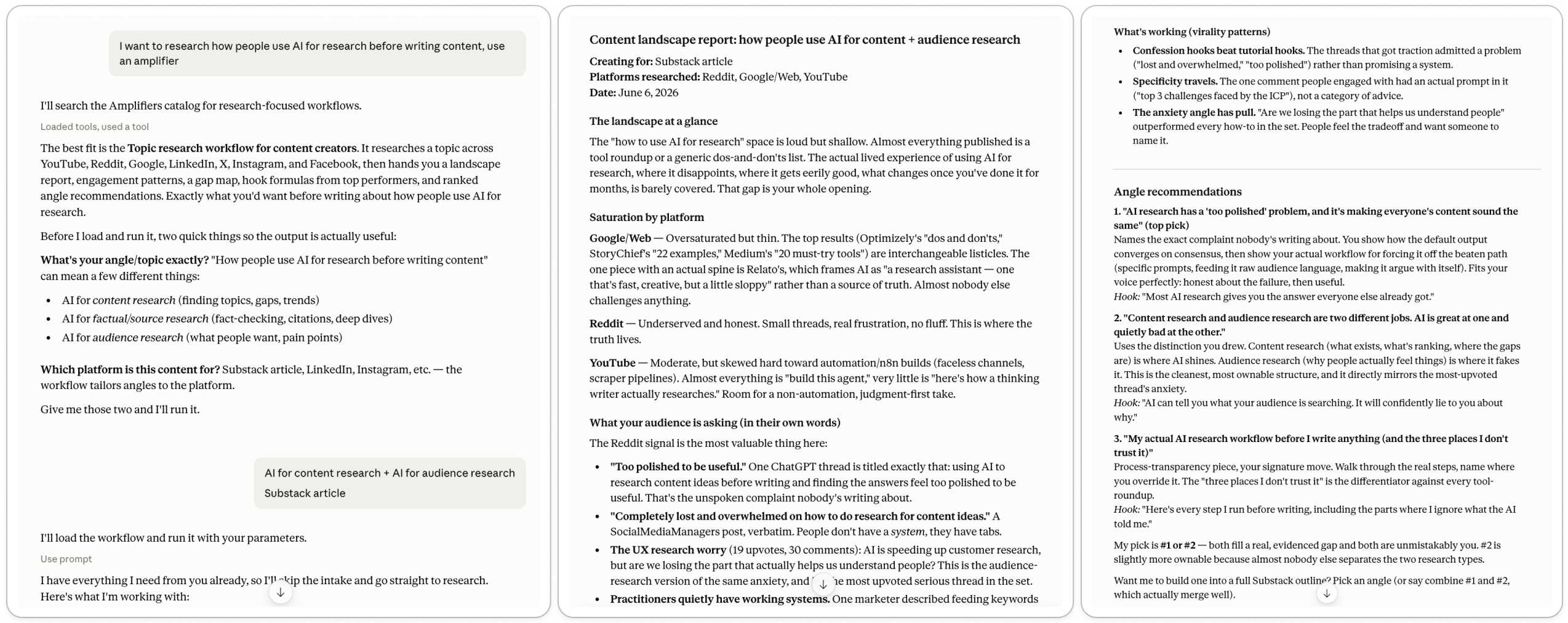
So by the time I sit down to write, I have a researcher who has already read what is out there and given me the sources behind it.
While I write, Amplifiers becomes my research and fact-checking backup. I use it to go deeper into anything I need to understand, verify claims, and pull current information into the article.
I also use a custom voice skill built with the Voice DNA Amplifier, so AI knows how to write like me. And as the article takes shape, I use other Amplifiers to create its thumbnail and the infographics I add throughout to explain the ideas more clearly.
Once the article is finished, my distribution AI agent takes over. Powered by Amplifiers and my voice, it becomes the social content and design team behind every piece.
It creates infographics for LinkedIn, X, Facebook, and Substack, along with carousels for Instagram and Threads, adapting each one to the way I communicate on that platform.
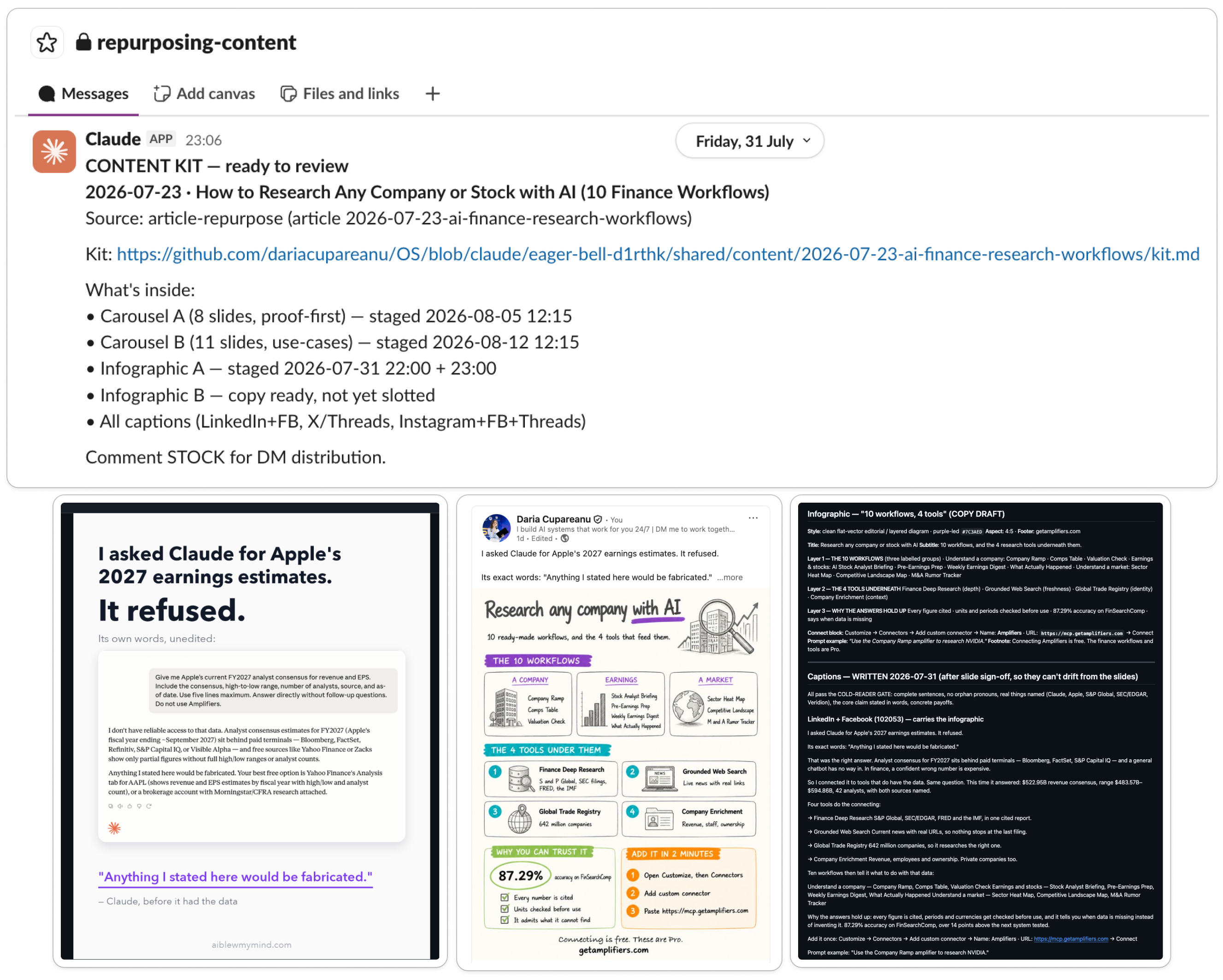
Beyond social media, it turns my articles into Gumroad products using a brand skill I built with the Brand Design Skill Builder Amplifier, then publishes them there for me.
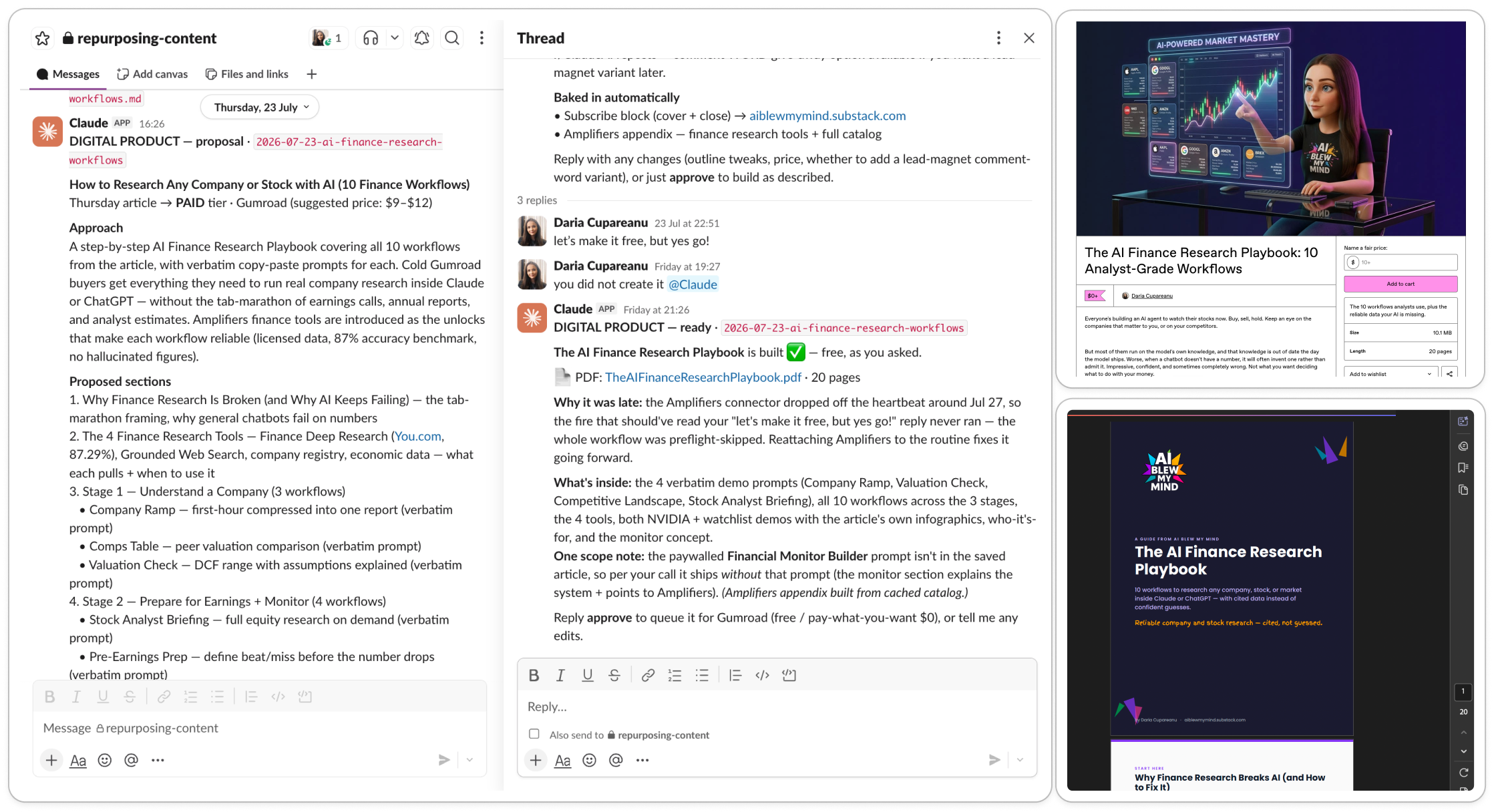
Repurposing one article properly could easily swallow an entire day. Now I publish the article, and the rest happens around me. I don’t have to sit down and turn it into five other things myself.
And then it creates completely new content too. It takes what it finds through my weekly trend research, uses Amplifiers to write the posts like me, and turns the best ideas into new carousels and infographics.
Across all of this, my part is the judgment. I review what it creates, give feedback, and approve everything before it goes live. The specialists, tools, and sources change as the work moves from research to writing, design, and distribution.
The work that wouldn’t happen without Amplifiers
This is what I mean when I say Amplifiers powers my business.
If I had to do all of this myself without Amplifiers, the new social content simply wouldn’t exist, and the repurposing would happen far less often. I don’t have time to do it all.
At one point, I seriously considered hiring someone to take over all of my social media work. But now I don’t have to. The team I thought I needed to hire lives inside the distribution system you just saw. Amplifiers gives its agents the capabilities they need, so the work keeps moving every week.
Beyond social media, my daily work runs through a separate AI operating system, with Amplifiers built into it too. Whenever I start a task, it can pull in the right Amplifier for whatever the work needs.
So whether I’m writing an article, working on a client project, or building Amplifiers itself, I stay inside Claude or ChatGPT, and my AI “knows a guy” whenever the work calls for a capability we don’t have.
How I make sure my AI knows who to call
My systems follow repeatable processes that run the same way every time, so they already know which Amplifiers to use and when.
Daily work is much less predictable. I might be researching someone one moment, preparing a client proposal the next, and checking a claim ten minutes later.
So I added this rule to the global instructions in Claude and ChatGPT, as well as to the CLAUDE.md and AGENTS.md files used by my AI operating system:
When we begin a new task together, search the Amplifiers catalog using
find_amplifiersfor an Amplifier that could help before starting. Do not search again on every follow-up message. Only search when the work clearly changes to a new task.
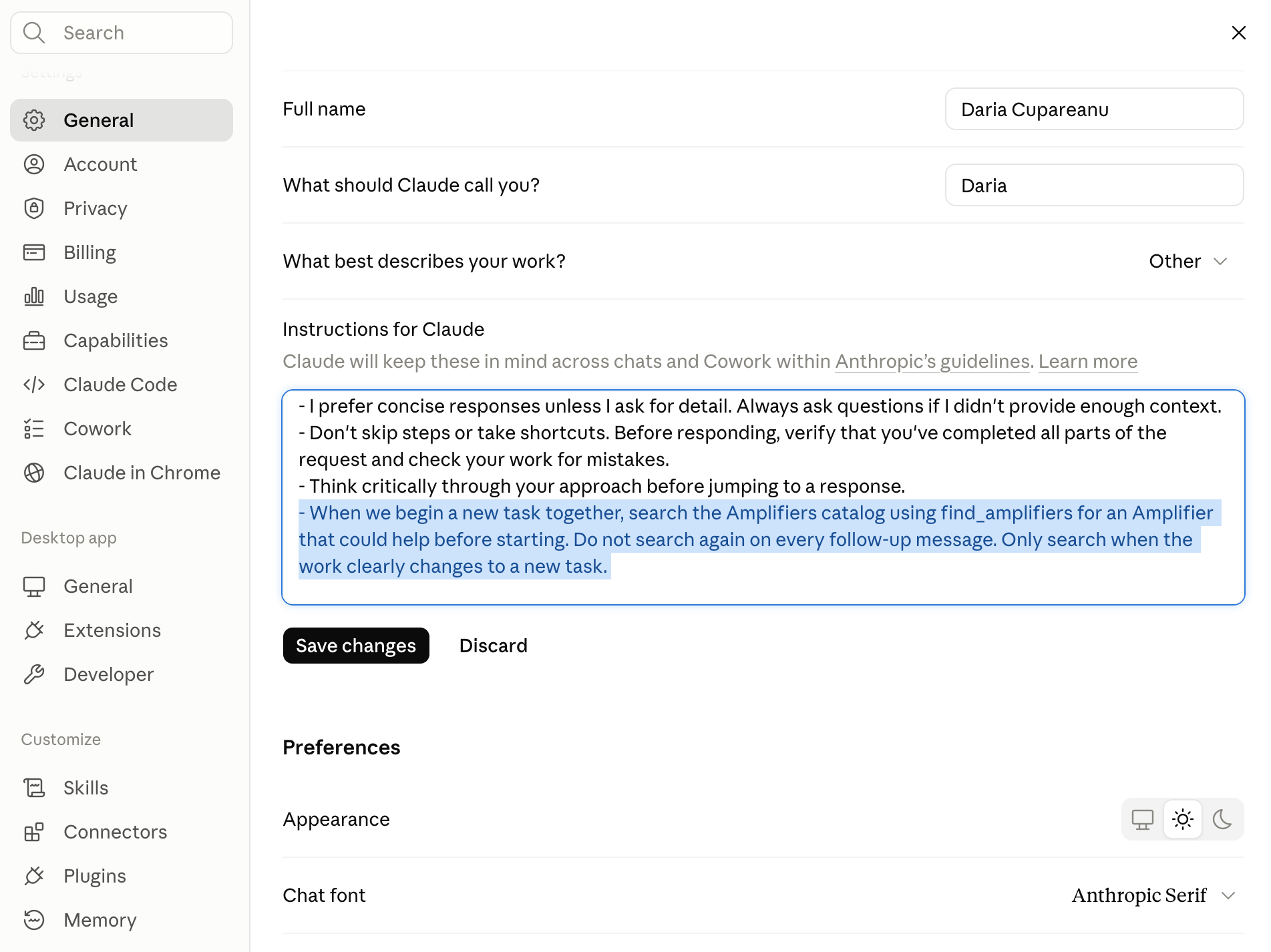
Why? Because even I cannot remember everything inside a catalog this large, and I created most of the workflows in it. With this rule, my AI checks for Amplifiers whenever we begin something new, without me having to ask every time.
You can add the same instruction to your AI. But if you don’t want it checking automatically, you still don’t need to know what is inside the catalog. Whenever you start a task, just say:
Find an Amplifier that can help me with this.
You bring the work. Your AI searches the Amplifiers catalog, finds the right backup, and plugs it in instantly.
The team looks different for everyone
My version of Amplifiers is shaped by content, research, and the systems behind my work. Other people are using it in completely different ways.
Adrienne Schutte is starting a business. She uses Amplifiers to work through its name, positioning, brand, and methodology. She now calls them an integral part of her workflow.
Tudor runs an agency that creates marketing videos. He uses the Prospect Research and Prospect Finder Amplifiers for sales and lead generation, helping him find and research potential clients beyond referrals as he grows the agency.
Michael Bridges uses Amplifiers throughout his process of creating content for Substack, from finding subject lines to creating Notes.
Julian runs an agency that creates social content for clients across several industries. He is using Amplifiers to work toward a repeatable production system inside Claude, with each client’s brand details, visual styles, and references built in.
Dallas Payne runs Neon White Interiors. She built a Claude project that tracks interior trends across five platforms and found “anti-beige rebellion” was getting the highest engagement. Keeping up with that wider picture would otherwise be a dedicated job she does not have time for.
Kim Doyal uses Amplifiers to skip the YouTube rabbit hole and get straight to what matters. After spending 15 minutes watching a video without reaching the useful part, she asked an Amplifier to watch it for her. What it pulled out became a content angle, then an entire YouTube strategy connected to what she was already building.
Brett uses Amplifiers to spend less time organizing and troubleshooting. He has used them to transcribe podcasts, create action notes, and generate a Fable prompt that audited and cleaned up his Obsidian vault, giving him more time for the work he cares about most: composing music and playing the piano.
These are only a few of the people I’ve spoken with, but they show how different the team becomes depending on what you do and what your work needs.
How I finally found a clear way to explain Amplifiers
By now, you’ve seen how much Amplifiers makes possible and how differently that can look from one person to the next. That is exactly why I found it so hard to sum up, and why I needed help stepping back from all the individual examples.
Going through the Clarity Map gave me exactly that. Its exercises helped me get everything out of my head and onto the map. As I listed how I use Amplifiers and what it gives me, Rich Carr helped me spot the bigger ideas running through it all.
By the end, we had three ideas that captured what Amplifiers is and what it makes possible for you.
The greatest hits of AI. Back when we bought CDs, you had to buy the whole album even if you only loved one or two songs. Greatest hits albums, and later YouTube playlists, gave us the best songs in one place. We want the best of the best from AI too, and that is what Amplifiers brings into yours: the best tools, expert workflows, sources, prompts, and capabilities, all in one place.
Whatever the work needs, plugged in on the spot. Rich saw a connection to The Matrix. When Trinity is asked if she can fly it, her answer is, “Not yet.” Seconds later, the pilot program is loaded and she takes off. Amplifiers works like that for you and your AI. When the work calls for a capability neither of you has, you can plug it in instantly and “not yet” becomes “now we can”.

You, amplified. Your AI gets access to more, and you are the one who gets to do more with it. Every new capability it can call becomes something you can use in your own work.
Together, those ideas gave me a way to turn everything I knew about Amplifiers into one thing I wanted you to remember:
AI’s dream team, inside your AI.
Why I’m sharing the Clarity Map with you
I had already tested the Clarity Map on my own with a difficult decision, and it helped me make up my mind. This time, I used it with Rich to work through the positioning for Amplifiers, something I had been putting off for months.
I’m so happy with where we landed, and I can’t tell you how much peace of mind finally having that clarity gave me.
I can see myself coming back to it for an important presentation, an article with too many competing ideas, another positioning problem, or even a difficult conversation where I need to work out what I want to say.
So if you want to see the process in action and use it for a message of your own, I highly recommend joining Rich’s Clarity Map webinar. And if you can’t attend, you can still try the Clarity Map yourself.
Now you get to be the judge. Did Amplifiers land for you this time? And if you already use it, I want to hear from you too: how does it help you, and how would you describe it to a friend or colleague?
This post is free. Paid subscribers get Amplifiers PRO, weekly premium articles, all premium resources inside the AI blew my mind Lab, and exclusive partner discounts. Upgrade here.
Daria! Readers: Do not skim past is one sentence in the middle: "Across all of this, my part is the judgment."
Two thousand users, three hundred workflows, agents running while you sleep, and the whole operation still routes through one human deciding what matters. That is the most honest description of working with AI I have read, and you wrote it in passing.
As for our time together, you did the hard part. You already knew everything about Amplifiers. You walked in carrying the whole album and walked out with the single. "AI's dream team, inside your AI" was in you the entire time, and watching it surface was the best hour of my week!
This looks so helpful. I need to give it a try but I am not even there yet... I am in an uncertain place as regards what I am , let alone how to position anything on that basis! 🫣