
Reverse Engineering: How I Use AI to Deconstruct What Works and Recreate It
The method I use almost every day to turn “that’s good” into “I can make my own version of this”. Images, ads, landing pages, content, prompts, whatever.

Every image I like, every landing page that makes me want to buy, every prompt that produces magic. I don’t just scroll past. I take it apart.
I figure out what makes it work. And then I rebuild it for myself.
This is reverse engineering. Studying a result and working backwards to understand how it was made. And with AI, this process became easy and accessible to anyone.
Last Sunday I shared the meta-process I use to get good results from any AI tool, even ones I’ve never touched before, by working with official documentation.
Today I want to go deeper into another part of how I work: using AI to deconstruct things I like and recreate them for my own context.
Before we dive in: there’s less than 4 days left until the 20% discount disappears. It’s the lowest price this publication will ever be. If you’ve been thinking about it, now’s the time.
The method
Across every use case, the process follows (more or less) the same structure:
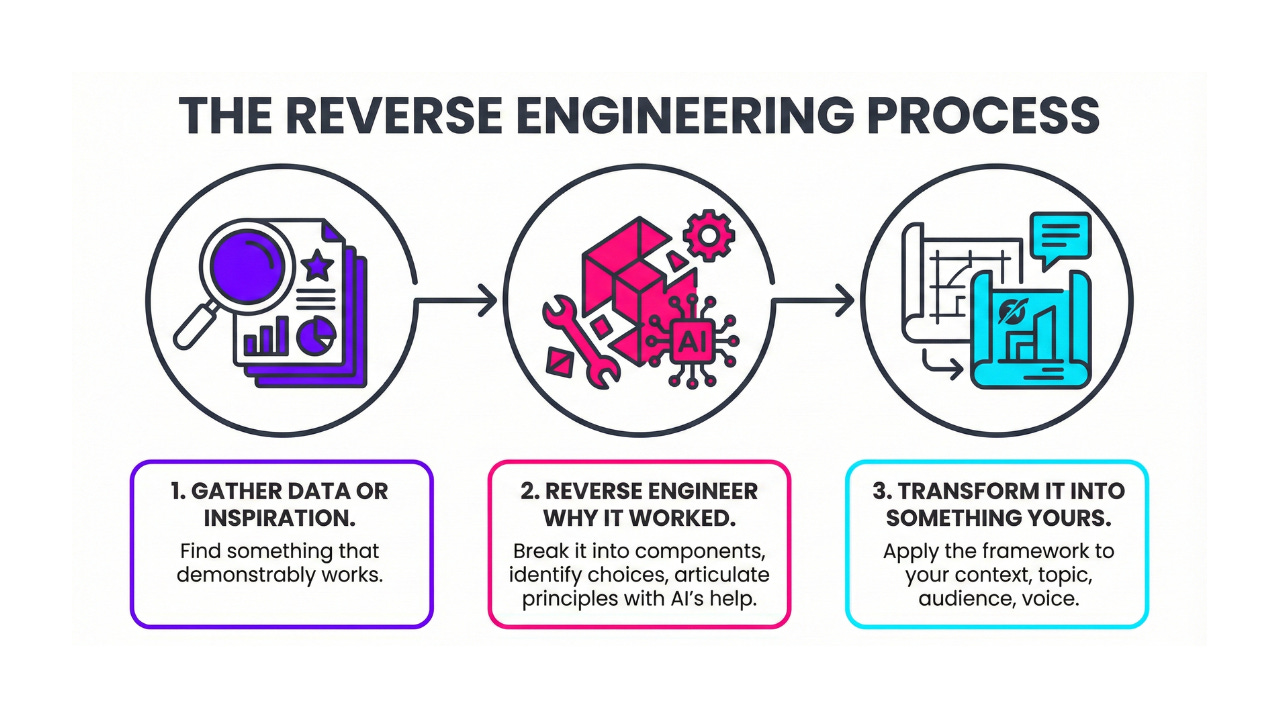
That’s it. Three steps.
Where can you use this?
I use reverse engineering almost every day. Images and ads. Content and posts. Landing pages and sales systems. Prompts. Even my own past work, to understand what performed well and why.
So the short answer is: anywhere you’re trying to create something and have examples of what good looks like.
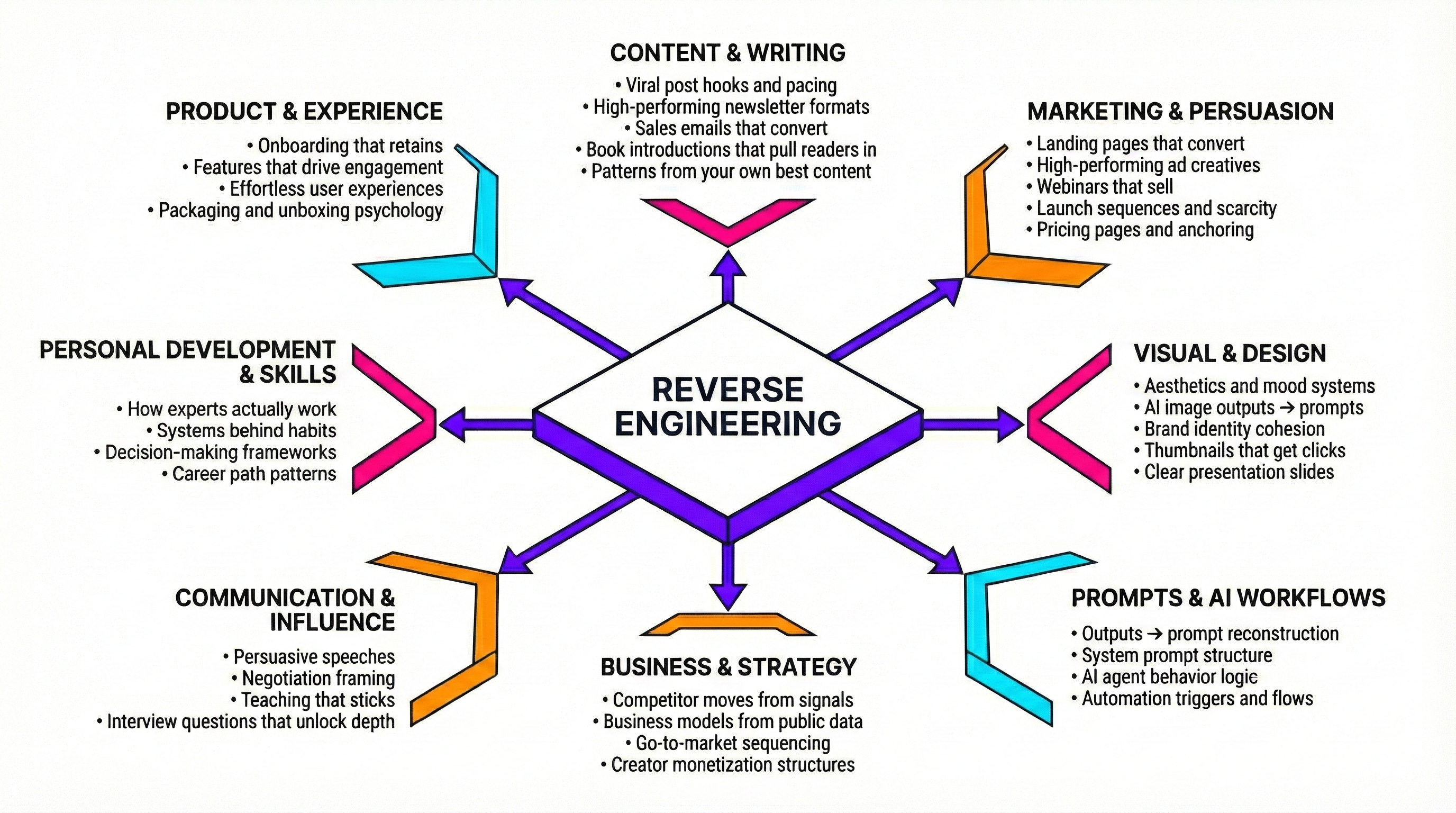
Let’s get into it
Today we’re going to explore several of these. I’m going deep on images in particular because that’s where there’s enormous leverage right now and the tools have gotten remarkably good. But the method applies to anything.
Here's what we're covering:
Example 1: Applying an art style to your photos (I turned my vacation photos into travel posters)
Example 2: Stealing a brand’s ad aesthetic (I reverse engineered Nike ads for a clothing brand)
Example 3: Recreating an infographic style for your brand (I made an isometric building explainer)
Example 4: Analyzing your top-performing content (I deconstructed my best Substack Notes)
Example 5: Reverse engineering a high-converting landing page (I broke down Justin Welsh’s sales page)
At the end, I’ll share links to my full Gemini conversations so you can see all the prompts and tweaks I did.
Part 1: Reverse engineering images & visuals
You see an image you love, ask AI to deconstruct it into a prompt, and then recreate that style infinitely with your own inputs.
I did this recently with human Christmas ornaments. I found an image I liked, reverse engineered the prompt, and used it to create ornaments of over 90 people for my Substack Christmas tree. See the process here.
Let me show you a few more ways this works.
Example 1: Reverse engineering a style to apply to new compositions
I thought about creating some small posters for myself, so I searched Pinterest for inspiration and found a painting style I liked. Vibrant, whimsical, like a colorful travel poster.
The process: I uploaded it into Gemini and asked AI to create a reusable prompt that captures the style. Then I applied it to my vacation photo from Tenerife.
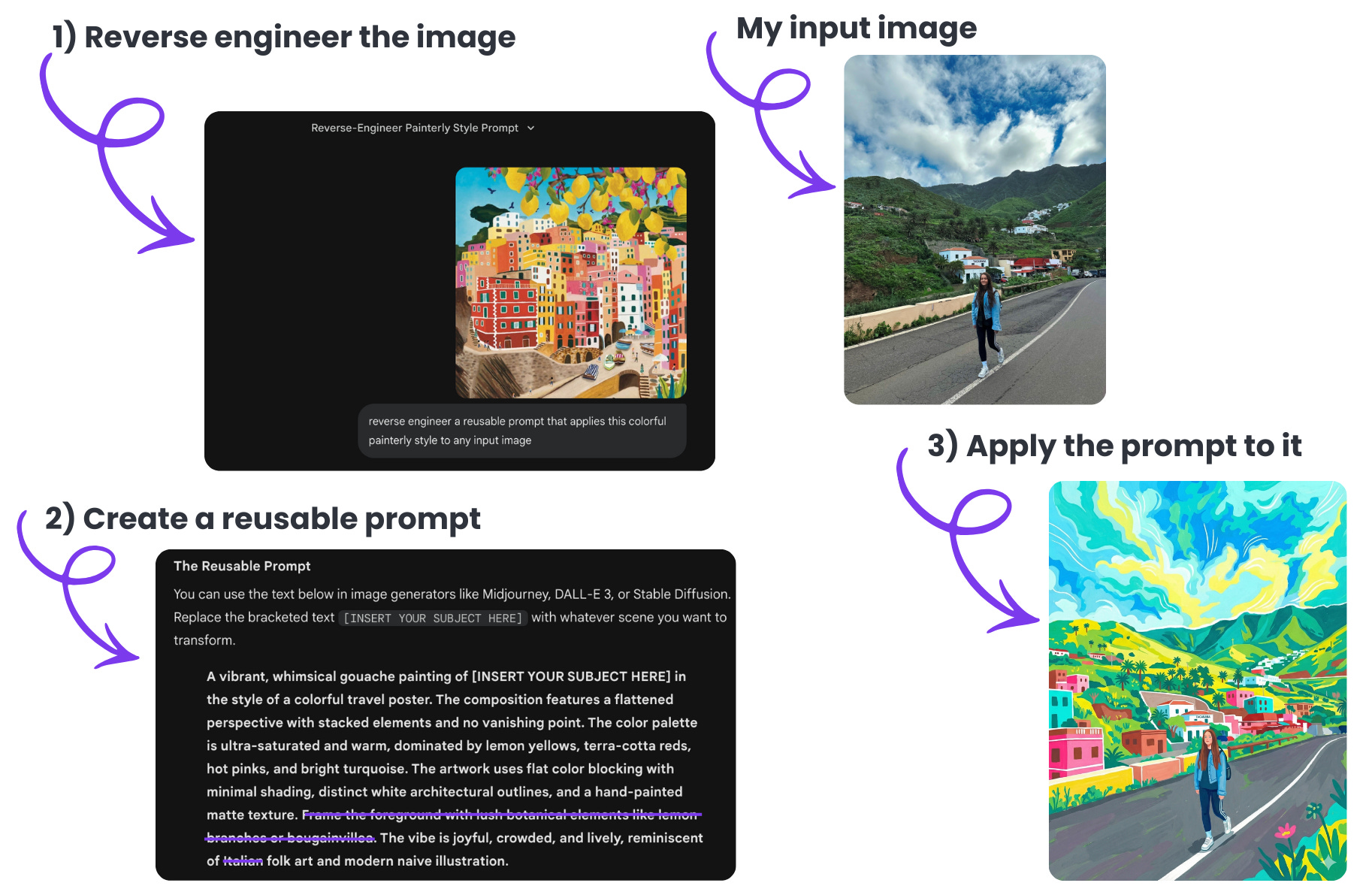
Note: When you ask AI to reverse engineer something, it will reverse engineer every bit of it. Most of the time, you don’t want that. My first template even had Italian influences baked in, which I didn’t need. So there’s almost always a bit of tweaking involved to make it flexible.
All prompts and conversation links are at the end of the article.
Example 2: Reverse engineering brand advertising styles
Let’s say you have a small hand-painted clothing brand built for “people who refuse mass sameness”. You admire Nike’s ad aesthetic and think it could fit your brand, so you want to learn from their approach and apply it to your own business.
The process: I took a screenshot of what Google generated when I searched for “Nike ads” and asked AI to deconstruct them into a reusable prompt. Then I applied the framework with my own photo and a hand-painted blazer I found on Pinterest.
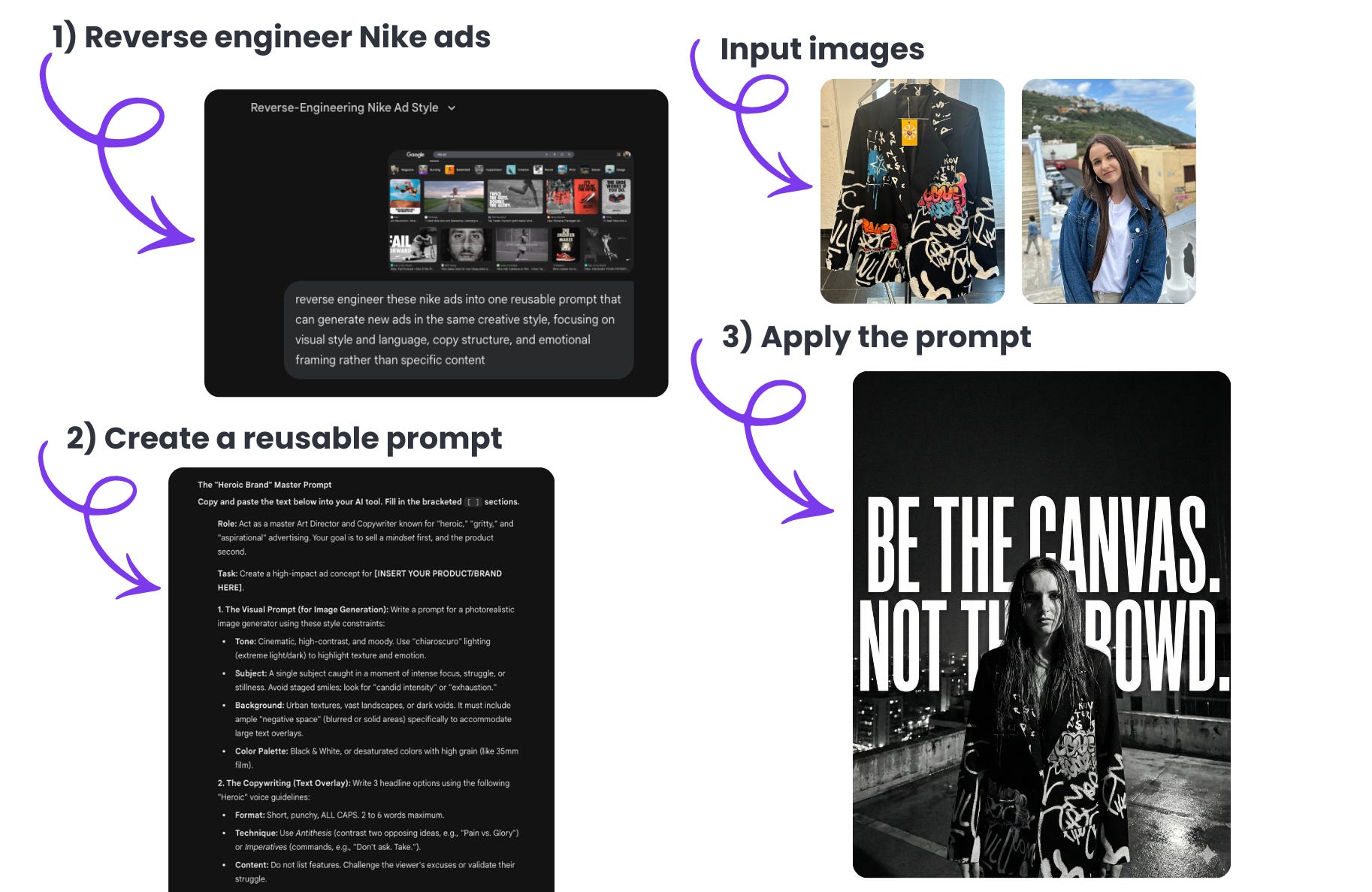
Note: For real production, you’d want some fine-tuning. The copy looks great, but the second row of text isn’t visible and should be moved up a bit. Still, a strong result for a first pass with minimal tweaks.
All prompts and conversation links are at the end of the article.
Example 3: Recreating an infographic style for your brand
I’m trying to create infographics for my articles that feel more coherent with my brand and colors. Up until now I focused more on getting the idea through visually, but now I want them to also follow a consistent style.
With reverse engineering, once you find a visual structure you like, you can break it down and reapply it using your own visual guidelines.
The process: I found an isometric building infographic on Pinterest where each floor represents a stage in a process. I uploaded it and asked AI to describe its visual style in a way that’s adaptable to different brand colors and content. Then I modified the prompt for my use case, added my brand guidelines, and generated the result.
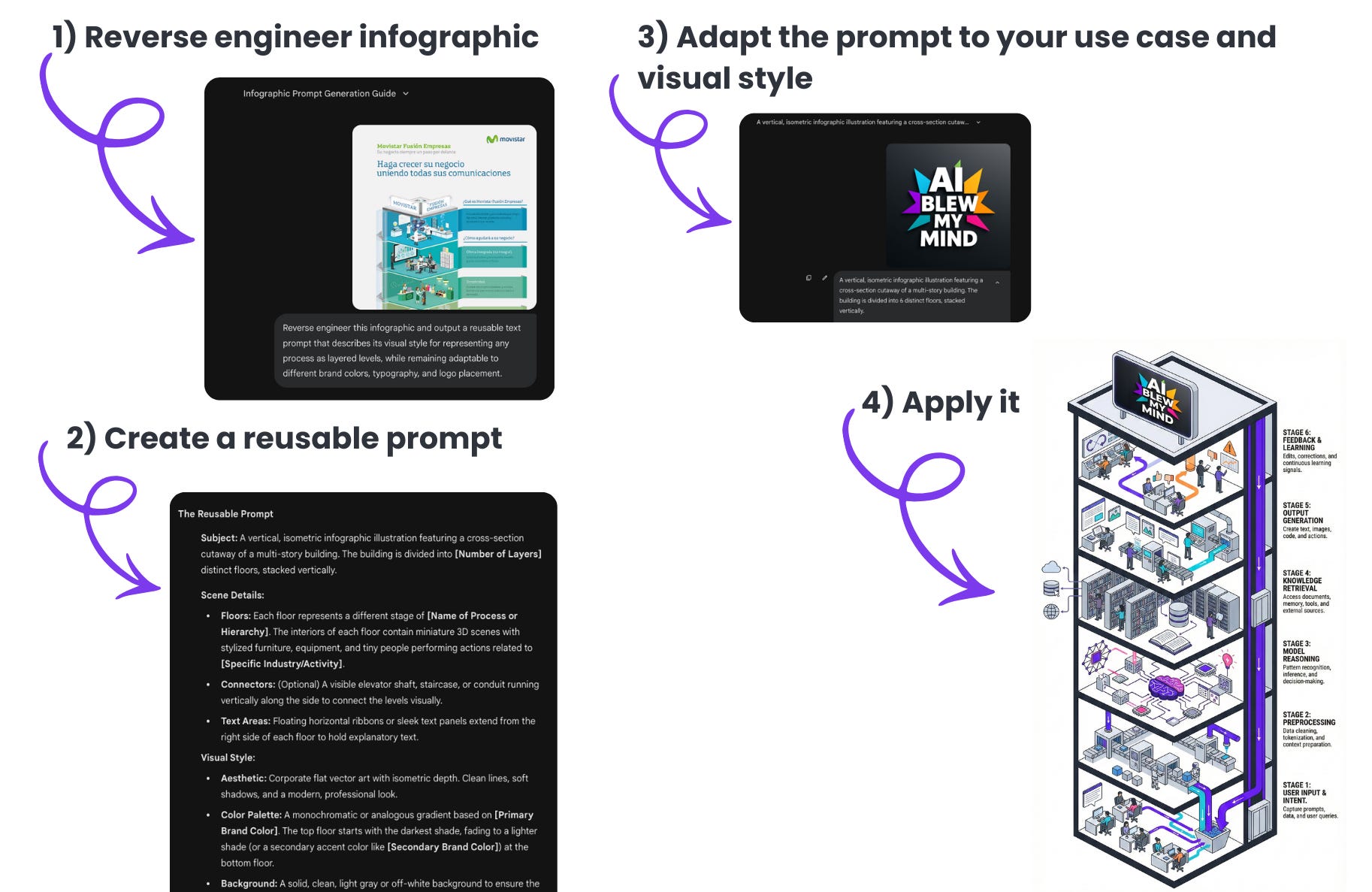
All prompts and conversation links are at the end of the article.
Part 2: Reverse engineering content & performance
Reverse engineering isn’t just for visuals. You can apply the same method to your own content to understand what’s working and why, then turn those patterns into a system.
Example 4: Analyzing your top-performing content to create a reusable formula
I wanted to understand why some of my Substack Notes performed better than others, and identify actual patterns I could replicate.
The process:
Step 1: Extract past notes. I created a simple automation in n8n to pull all my published Substack Notes into a spreadsheet using the Substack community node created by Jakub Slys 🤖.
Step 2: Export engagement data. Downloaded the spreadsheet with all the content (plus likes and restacks).
Step 3: Reverse engineer which Notes perform best and why. I uploaded the spreadsheet to AI with a prompt asking it to analyze my most engaged Notes. Identifying patterns in topics, hooks, structure, length, tone, and timing.
Step 4: Create a reusable prompt that captures the DNA of my best work. Based on all the insights, I asked AI to embed everything it learned and create a reusable prompt that generates new Notes modeled after my best-performing ones.
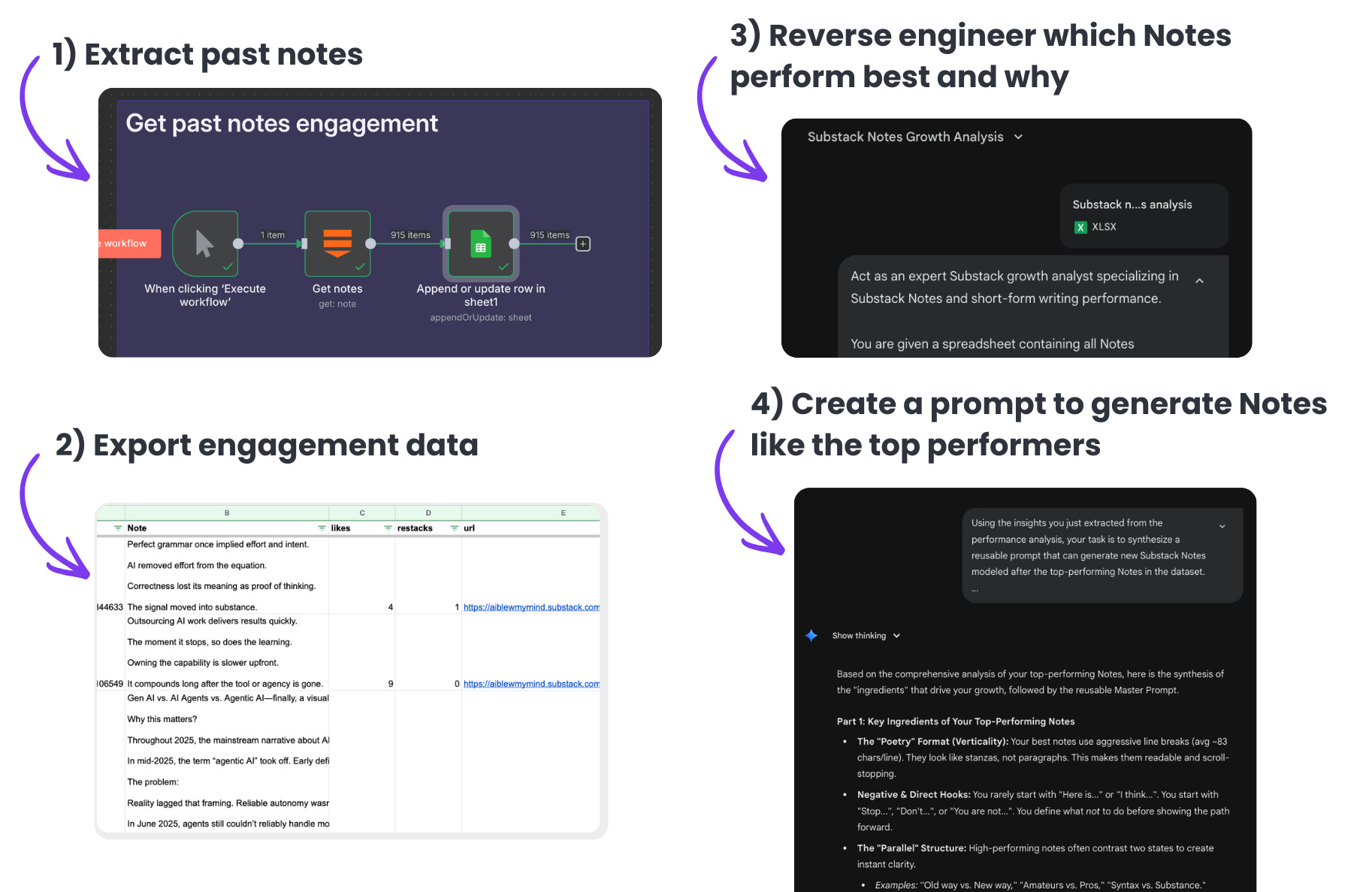
Note: I also reverse-engineered my top articles and LinkedIn posts. The patterns AI surfaced were very revealing. And you can do the same with other people’s content too. Analyze their techniques to understand what makes them work or deconstruct hooks from posts that go viral (once you have enough examples to feed into AI).
All prompts and conversation links are at the end of the article.
Part 3: Reverse Engineering systems & strategy
Reverse engineering also works for understanding larger systems. How conversion funnels work. How products are structured. How experts have built what they’ve built.
Example 5: Reverse engineering a high-converting landing page
I don’t have a product launch right now. But if I did, this is exactly how I’d start. Find sales pages with proven high conversions, created by experts, and reverse engineer the underlying framework.
So for the purpose of the example, I used Justin Welsh’s course landing page.
The process: I uploaded screenshots of the full page and asked AI to analyze it as a conversion system. AI produced a comprehensive breakdown. The psychological flow (Hook → Empathy → Authority → Logic → Qualification → Action). Visual principles (narrow reading column, section “zoning” with color, device mockups for tangibility). A step-by-step module structure I could apply to any product.
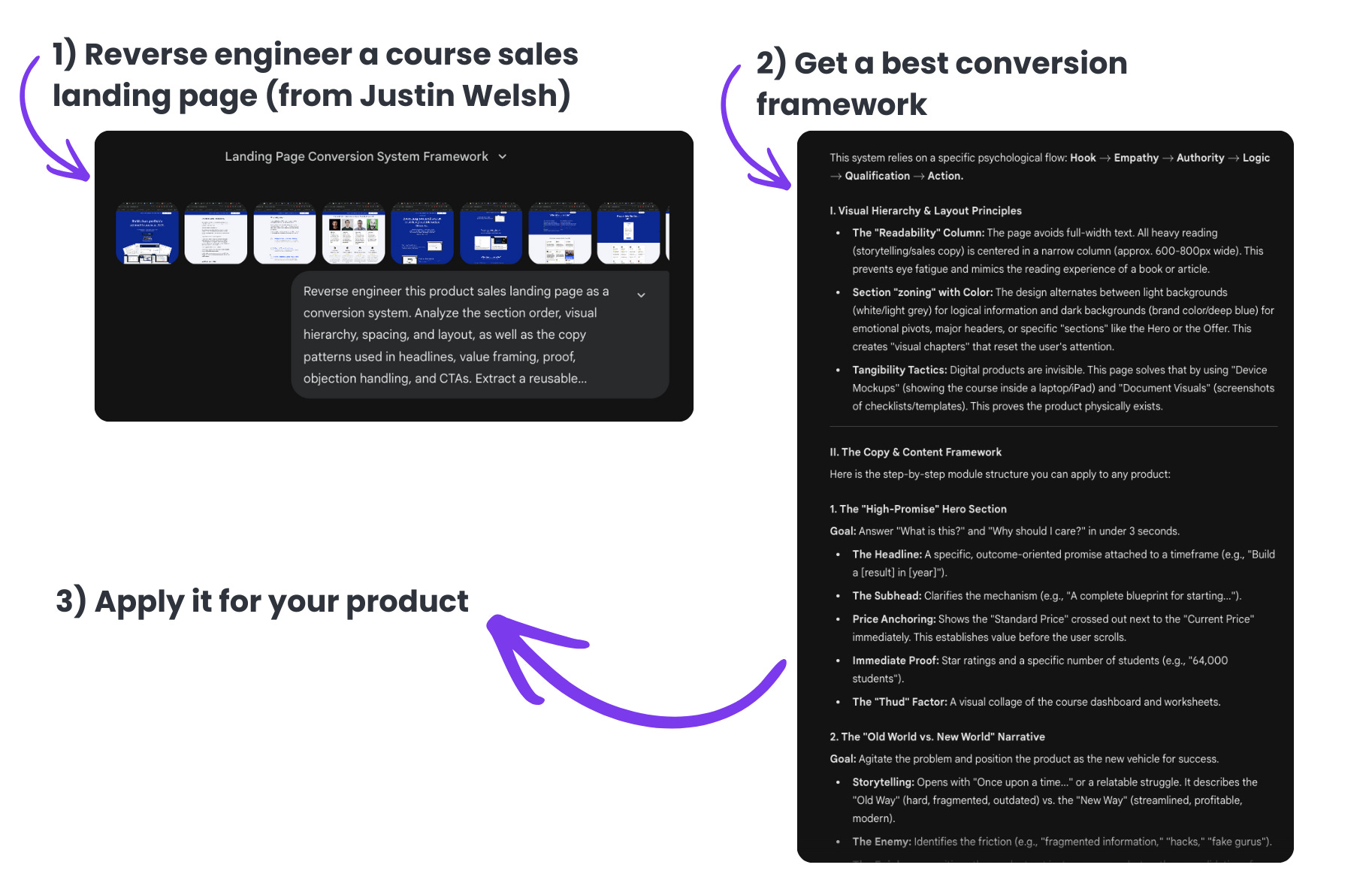
Note: I didn’t recreate a landing page in this example. But the framework is now in my toolkit. When I’m ready to launch something, I won’t start from zero. I’ll start from proven principles extracted from someone who’s mastered this. And I’d continue to expand the list with more examples similar to the product I’m trying to sell.
All prompts and conversation links are at the end of the article.
What to take from this
These are things I do regularly. And there are many more applications I didn’t cover.
Reverse engineering the prompt behind another prompt. Reverse engineering a product to vibe-code a similar one. Reverse engineering competitor strategies from what they do publicly.
Across all these use cases, the real takeaway is the method:
Gather. Find what works.
Deconstruct. Use AI to identify why.
Reconstruct. Use AI to apply it to your context.
What used to require time and insider experience can now surface in a single conversation. What still stands is taste (choosing the right inspiration) and judgment (figuring out how to adapt it to your goals and make it yours).
The only thing that has changed is access.
Ready to reverse engineer something yourself? Below you’ll find every prompt and conversation from this article. The full back-and-forth with AI, all the tweaks I made, everything you need to replicate these results and adapt them for your own projects.
Premium subscribers get access to all of this, plus every other process I’ve documented in the LAB.
Grab the prompts and conversations
If you want to see exactly how I prompted, how I iterated (and tweaked things along the way), and what the full outputs looked like, I’ve linked all my Gemini conversations below.
Example 1: Vacation photos → travel posters